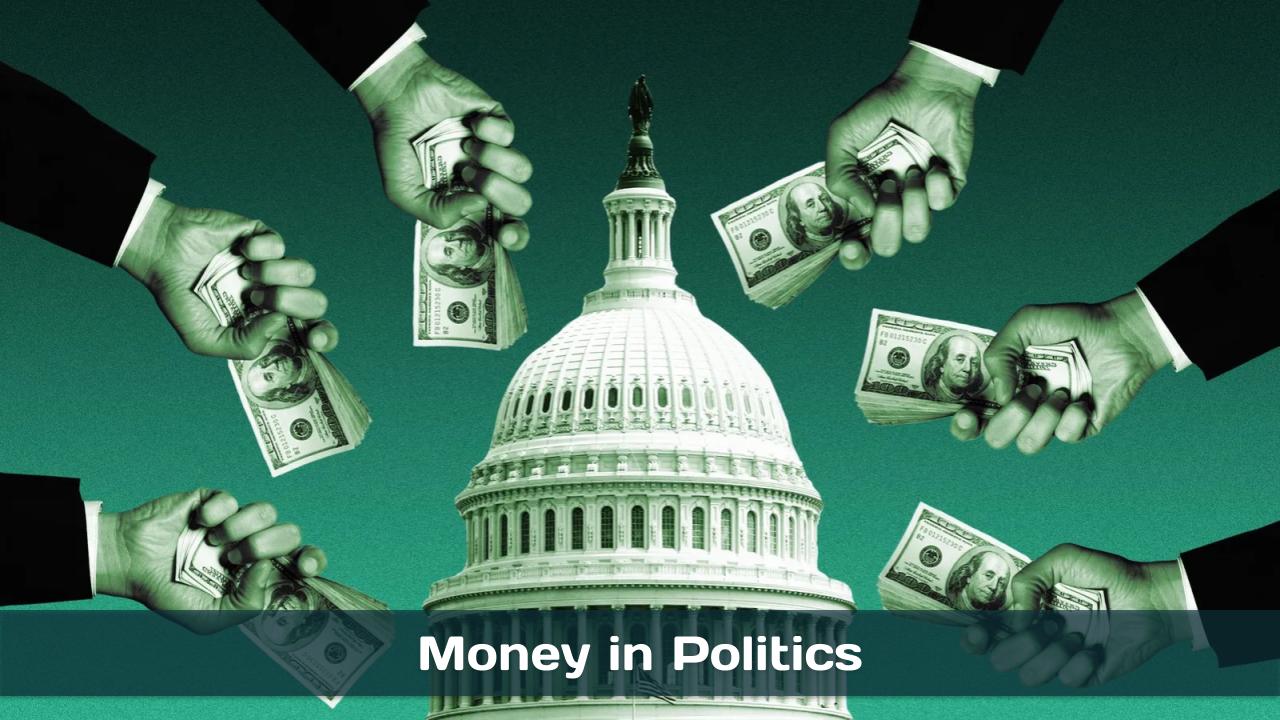
Summary
Money in politics refers to the influence of financial contributions on political campaigns, elections, and policy decisions. This topic is highly debated and controversial due to concerns about fairness, transparency, and the potential for corruption.
- In the ‘About’ section of this post is an overview of the issues or challenges, potential solutions, and web links. Other sections have information on relevant legislation, committees, agencies, programs in addition to information on the judiciary, nonpartisan & partisan organizations, and a wikipedia entry.
- To participate in ongoing forums, ask the post’s curators questions, and make suggestions, scroll to the ‘Discuss’ section at the bottom of each post or select the “comment” icon.
The Money in Politics category has related posts on government agencies and departments and committees and their Chairs.
Frontline PBS – 02/01/2023
How did the Supreme Court’s 2010 Citizens United decision change political campaigns in America? In 2012, FRONTLINE and APM’s Marketplace investigated how the controversial ruling was playing out in Montana, an epicenter of the campaign finance debate. (Aired 2012).
As this documentary, “Big Sky, Big Money,” explored, the Citizens United decision held that political spending is a form of protected speech, and let corporations and unions spend unlimited amounts of money in campaigns. But to avoid corruption, the court said the money can’t go directly to candidates; it has to go to independent outside groups.
What did that mean in reality? As the 2012 election loomed, correspondent Kai Ryssdal traveled to Montana, then a battleground over campaign finance, and uncovered startling new evidence of outside interest groups’ influence on local campaigns. The documentary raised questions about how secret “dark money” was transforming U.S. politics, looked at a boom in ads made by tax-exempt nonprofits known as 501(c)(4)s — which generally weren’t required to disclose their donors publicly — and probed evidence that appeared to show possible coordination with campaigns.
“Big Sky, Big Money” is a FRONTLINE production with American Public Media’s Marketplace in association with American University’s School of Communications Investigative Reporting Workshop. The writer, producer and director is Rick Young. The correspondent is Kai Ryssdal.
OnAir Post: Money in Politics
News
PBS NewsHour – September 16, 2012 (16:08:23)
Former Supreme Court Justice David Souter sat down with Margaret Warner, speaking about how there are some laws that Congress can make that can limit the freedom of speech, and addressed the controversial Citizens United decision.
Politics has a spending problem. A constitutional amendment can fix this and unite people across the political spectrum.
Last month marked the anniversary of two Supreme Court cases that fundamentally reshaped our system of representative self-government: Citizens United v. FEC from 2010 and Buckley v. Valeo from 1976. Many Americans recognize Citizens United, but they may be less familiar with Buckley, which is when the court first positioned itself as the chief decision-maker for how money in politics is regulated. Buckley treated election spending as equivalent to protected speech, removing legislators’ and voters’ power to set their own limits. This fundamentally changed power and accountability by giving wealthy people and organizations more influence in elections.
Buckley was the first Supreme Court decision to invoke the First Amendment to treat political spending in elections as a protected expression of an idea, striking down campaign finance laws as unconstitutional that would cap spending. The court expanded that protection to corporations, unions and other artificial entities in Citizens United.
For nearly 50 years, spending in elections by special interest groups – and even foreign governments – has spiraled out of control. Spending records are broken every election cycle. Nearly $16 billion may be spent in the 2024 cycle alone, up more than 30% from the last presidential election campaign.
About
Challenges
Legal and Regulatory Challenges:
- Lack of Clear and Enforceable Laws: Many countries lack comprehensive and effective laws governing money in politics, creating loopholes that allow for the improper influence of special interests.
- Inadequate Disclosure Requirements: Disclosure of political contributions and spending is often insufficient or incomplete, making it difficult to track the sources and impact of money in politics.
- Limited Enforcement Mechanisms: Weak enforcement mechanisms and penalties make it challenging to deter violations and hold actors accountable.
Political Challenges:
- Incumbent Advantage: Incumbents often benefit disproportionately from money in politics due to advantages like name recognition, campaign funds, and access to official resources.
- Gridlock and Partisanship: Heavy reliance on private funding can lead to gridlock and partisan stalemates, as lawmakers become beholden to special interests.
- Democratic Deficit: The perception that money in politics skews the system in favor of the wealthy and powerful undermines public trust in democracy.
Economic Challenges:
- Dependence on Private Funding: Electoral systems that rely heavily on private funding create incentives for candidates to seek contributions from wealthy donors and corporations, potentially compromising their independence.
- Campaign Finance Burdens: High campaign costs can act as a barrier to entry for candidates, particularly those from diverse backgrounds or without access to significant wealth.
- Economic Inequality: Money in politics can exacerbate economic inequality by giving undue influence to the wealthy and corporations over policy decisions.
Technological Challenges:
- Opaque Fundraising Platforms: The rise of online fundraising and social media platforms has made it easier for donors to conceal their identities and circumvent disclosure requirements.
- Targeted Political Advertising: Sophisticated targeting algorithms allow campaigns to microtarget voters with tailored ads, potentially influencing electoral outcomes unfairly.
- Misinformation and Disinformation: Money in politics can contribute to the spread of misinformation and disinformation aimed at influencing public opinion.
Ethical and Values Challenges:
- Corruption and Misuse of Power: Money in politics can create opportunities for corruption, bribery, and misuse of public power.
- Erosion of Public Confidence: The perception of undue influence by special interests damages public trust in elected officials and the political system.
- Undermining Democratic Principles: Money in politics challenges fundamental principles of democracy, such as equality, representation, and accountability.
Source: Google Search + Gemini + onAir curation
Solutions
1. Campaign Finance Reform:
- Stricter limits on campaign contributions: Reduce the influence of large donors by capping the amount individuals and organizations can contribute to candidates.
- Public financing of elections: Provide all candidates with a fair chance by matching small donations with public funds or directly funding campaigns.
- Ban on corporate and union contributions: Prevent corporations and unions from directly funding political campaigns, eliminating the potential for undue influence.
2. Disclosure and Transparency:
- Real-time reporting of campaign donations: Require candidates to disclose all donations promptly, allowing the public to monitor campaign financing in real time.
- Strengthening independent oversight: Empower independent agencies to monitor campaign finance compliance and investigate potential violations.
- Access to donation information: Provide the public with easy access to comprehensive information about campaign donations.
3. Citizen Engagement and Empowerment:
- Encouraging small donations: Promote grassroots funding by making it easier for individuals to contribute small amounts.
- Civic education and voter registration: Educate citizens about the importance of clean elections and encourage their participation in the political process.
- Protecting whistleblowers: Ensure that individuals who report campaign finance violations are protected from retaliation.
4. Legislative and Regulatory Changes:
- Bans on “dark money” spending: Prohibit organizations from spending unlimited amounts on political ads without disclosing the sources of their funding.
- Reform of Super PACs: Increase transparency and regulation of Super PACs, limiting their independence and influence.
- Closing loopholes: Address loopholes that allow for the circumvention of campaign finance laws.
5. Cultural and Normative Shifts:
- Promote ethical values: Encourage ethical behavior among candidates, donors, and campaign officials.
- Reduce the role of money: Emphasize the importance of ideas and policies over financial resources in political campaigns.
- Engage in open dialogue: Foster public discussions and debate about the challenges of money in politics.
Source: Google Search + Gemini + onAir curation
Websites
Government and Regulatory Agencies:
- Federal Election Commission (FEC): https://www.fec.gov
- Center for Responsive Politics (OpenSecrets): https://www.opensecrets.org
Nonprofit Organizations:
- Campaign Legal Center: https://www.campaignlegalcenter.org
- Citizens United Reform Center: https://www.citizensunitedreformcenter.org
- Democracy 21: https://www.democracy21.org
- End Citizens United: https://www.endcitizensunited.org
- Public Citizen: https://www.citizen.org
Academic Research Centers:
- Brennan Center for Justice at NYU School of Law: https://www.brennancenter.org
- Center on Budget and Policy Priorities: https://www.cbpp.org
- Open Government Institute at the University of California, Berkeley: https://www.ogi.berkeley.edu
News and Media:
- Center for Public Integrity: https://publicintegrity.org
- Independent Media Institute: https://www.independentmediainstitute.org
- Mother Jones: https://www.motherjones.com
- The Intercept: https://theintercept.com
- The New Republic: https://newrepublic.com
Online Resources:
- InfluenceMap: https://influencemap.org
- Politwoops: https://politwoops.org
- Sunlight Foundation: https://sunlightfoundation.com
Source: Google Search + Gemini + onAir curation
Legislation
Laws & Appropriations
Source: Google Search + Gemini + onAir curation
Key Congressional Laws for Addressing Money in Politics
1. Bipartisan Campaign Reform Act of 2002 (McCain-Feingold)
- Limited soft money donations to national party committees.
- Raised individual contribution limits to candidates.
- Created a new category of “527 groups” that could engage in independent expenditures.
- Required disclosure of all campaign contributions.
Challenges:
- Supreme Court rulings in Citizens United v. FEC (2010) and McCutcheon v. FEC (2014) loosened campaign finance regulations.
- 527 groups have become a major loophole for undisclosed political spending.
- Super PACs, which can raise and spend unlimited amounts of money, have proliferated.
2. Honest Leadership and Open Government Act of 2007 (HOLOG)
- Prohibited lobbyists from paying for meals, drinks, or travel for members of Congress.
- Required disclosure of all gifts and travel expenses from lobbyists.
- Created an ethics oversight commission.
Challenges:
- Lobbyists have found loopholes to circumvent the gift ban.
- The ethics oversight commission has been criticized for being toothless.
- There is no cap on lobbying spending.
3. DISCLOSE Act
- Required groups spending more than $10,000 on political ads to disclose their top donors.
- Claimed to close the “dark money” loophole.
Challenges:
- Struck down by a federal court in 2010.
- Several similar proposals have been introduced in Congress but have not passed.
4. Fair Elections Now Act (FENA)
- Proposed publicly funded elections for congressional races.
- Would provide matching funds to candidates who meet certain criteria.
- Designed to reduce the influence of big money in politics.
Challenges:
- Has not been passed by Congress.
- Faces opposition from both Democrats and Republicans.
- May be unconstitutional.
5. Clean Campaign Act of 2019
- Proposed restrictions on corporate and union spending in federal elections.
- Would lower individual contribution limits.
- Banned foreign entities from donating to U.S. candidates.
Challenges:
- Has not been passed by Congress.
- Faces opposition from business groups.
- May be difficult to enforce.
Bills
Sampling of Bills
H.R.7244 — End Tax Breaks for Dark Money Act
Sponsor: Chu, Judy [Rep.-D-CA-28] (Introduced 02/06/2024)
Cosponsors: (15)
Committees: House – Ways and Means
Latest Action: House – 02/06/2024 Referred to the House Committee on Ways and Means. (All Actions)
H.R.1118 — DISCLOSE Act of 2023
Sponsor: Cicilline, David N. [Rep.-D-RI-1] (Introduced 02/21/2023)
Cosponsors: (153)
Committees: House – House Administration; Ways and Means; Judiciary
Latest Action: House – 07/11/2023 ASSUMING FIRST SPONSORSHIP – Mr. Pappas asked unanimous consent that he may hereafter be considered as the first sponsor of H.R. 1118, a bill originally introduced by Representative Cicilline, for the purpose of adding cosponsors and requesting reprintings pursuant… (All Actions)
H.R.5048 —Protecting Our Democracy Act
Sponsor: Schiff, Adam B. [Rep.-D-CA-30] (Introduced 07/27/2023)
Cosponsors: (158)
Committees: House – Oversight and Accountability; Judiciary; House Administration; Budget; Transportation and Infrastructure; Rules; Foreign Affairs; Ways and Means; Intelligence (Permanent Select)
Latest Action: House – 07/28/2023 Referred to the Subcommittee on Economic Development, Public Buildings, and Emergency Management. (All Actions)
Committees, Agencies, & Programs
Committees
Source: Google Search + Gemini + onAir curation
House of Representatives:
- Committee on Administration (oversight of the House Ethics Committee)
- Committee on House Administration (funding and oversight of House operations, including campaign finance)
- Committee on Oversight and Reform (investigative powers to examine public policy and government operations, including campaign finance)
Senate:
- Committee on Rules and Administration (oversight of Senate Ethics Committee, campaign finance laws, and electoral reform)
- Committee on Homeland Security and Governmental Affairs (oversight of federal elections, including campaign finance and election security)
Joint Committees:
- Joint Committee on the Library (responsible for the Library of Congress, which maintains an extensive collection of materials on campaign finance)
- Joint Committee on Taxation (review and advise on tax legislation, including provisions related to political contributions)
Other Relevant Committees:
- Senate Judiciary Committee (oversight of federal criminal laws, including campaign finance violations)
- House Judiciary Committee (oversight of federal criminal laws)
- Senate Committee on Finance (oversight of tax legislation)
- House Committee on Ways and Means (oversight of tax legislation)
Congressional Caucuses:
- Congressional Reform Caucus (advocates for campaign finance reform and ethics in government)
- Congressional Progressive Caucus (supports measures to reduce the influence of money in politics)
Government Agencies
Source: Google Search + Gemini + onAir curation
Federal Election Commission (FEC)
- Enforces campaign finance laws and regulations
- Registers political committees and candidates
- Discloses campaign contributions and expenditures
- Investigates violations and imposes civil penalties
Internal Revenue Service (IRS)
- Enforces tax laws related to political activity
- Audits political organizations and individuals for compliance
- Reviews tax-exempt status of organizations involved in政治活动
Department of Justice (DOJ)
- Prosecutes violations of federal campaign finance laws
- Investigates allegations of corruption and bribery
- Enforces laws prohibiting foreign interference in elections
Federal Bureau of Investigation (FBI)
- Investigates potential violations of federal election laws
- Conducts background checks on political candidates and appointees
- Provides intelligence on threats to election integrity
Securities and Exchange Commission (SEC)
- Enforces securities laws related to corporate political spending
- Reviews disclosures of political contributions by public companies
- Investigates allegations of insider trading related to political information
Federal Communications Commission (FCC)
- Regulates political advertising on radio and television
- Enforces equal-time and fairness doctrines that ensure fair representation of candidates
- Monitors political content on broadcasting stations
Government Accountability Office (GAO)
- Conducts audits and investigations related to campaign finance
- Reports on the effectiveness of election laws and regulations
- Makes recommendations for improvements to election administration
Government Programs & Initiatives
Source: Google Search + Gemini + onAir curation
Legislation:
- Bipartisan Campaign Reform Act of 2002 (McCain-Feingold Act): Restricted soft money donations to political parties and limited independent expenditures.
- Citizens United v. Federal Election Commission (2010): Supreme Court ruling that overturned restrictions on corporate and union spending in elections.
- Honest Ads Act of 2019: Requires online platforms to maintain public records of political advertising and disclose who purchased them.
Agencies:
- Federal Election Commission (FEC): Regulates campaign finance and enforces campaign finance laws.
- Internal Revenue Service (IRS): Enforces tax laws that apply to political activities and organizations.
Initiatives:
- Public Citizen’s Democracy for All: A nonpartisan organization that advocates for campaign finance reform.
- Brennan Center for Justice’s Democracy Program: Conducts research and develops policy proposals to reduce the influence of money in politics.
- Campaign Legal Center: A nonpartisan watchdog organization that litigates cases and advocates for campaign finance reform.
Other Efforts:
- Executive Orders: Presidents have issued executive orders to restrict certain campaign finance activities, such as Obama’s Executive Order on Reducing the Influence of Super PACs.
- State and Local Laws: Some states and cities have implemented their own campaign finance laws to address money in politics, such as campaign finance disclosure requirements and public financing systems.
Potential Reforms:
- Constitutional Amendments: Proposals to overturn Citizens United or amend the Constitution to limit the influence of money in politics.
- Public Financing of Elections: Proposals to provide public funding for elections, reducing the need for private donations.
- Campaign Finance Transparency: Proposals to enhance disclosure requirements and improve public access to campaign finance information.
- Campaign Spending Limits: Proposals to impose limits on the amount of money that candidates and campaigns can raise and spend.
- Small Donor Matching Systems: Proposals to match small donations to candidates, amplifying the voices of individual donors.
More Information
Judiciary
Source: Bard AI + onAir curation
The relationship between the judiciary and money in politics is a complex and often controversial topic. While the judiciary is meant to be impartial and independent, the influence of money can raise concerns about its fairness and effectiveness.
Key Issues and Concerns:
- Campaign Contributions:
- Direct Influence: Donations to judicial candidates can create a perception of bias, as judges may feel indebted to their donors.
- Indirect Influence: Large campaign contributions can give donors greater access to judges, potentially influencing their decisions.
- Lobbying:
- Interest Groups: Powerful interest groups can lobby judges to influence their rulings on issues that affect their interests.
- Revolving Door: Judges who retire or leave the bench may find lucrative employment in industries they previously oversaw, raising concerns about conflicts of interest.
- Judicial Independence:
- Financial Security: Judges who rely on campaign contributions may feel pressure to rule in ways that please their donors to ensure future financial security.
- Public Perception: The perception of judicial bias can erode public trust in the legal system.
Efforts to Address These Concerns:
- Campaign Finance Reform: Limiting campaign contributions and increasing transparency can help reduce the influence of money on judicial elections.
- Ethical Rules: Stricter ethical rules for judges can help prevent conflicts of interest and maintain public trust.
- Public Financing: Publicly funded judicial campaigns can reduce reliance on private donations.
- Recusal Standards: Clear recusal standards can help judges avoid conflicts of interest and maintain impartiality.
Ongoing Debate and Challenges:
Despite these efforts, the relationship between the judiciary and money in politics remains a subject of ongoing debate. Challenges include:
- Effectiveness of Reforms: The effectiveness of reforms in limiting the influence of money is often debated.
- Public Awareness: Public awareness of these issues can be limited, making it difficult to generate support for reforms.
- Political Polarization: Partisan divisions can make it difficult to reach consensus on reforms.
In conclusion, the relationship between the judiciary and money in politics is a complex and multifaceted issue. While efforts have been made to address these concerns, the ongoing debate highlights the need for continued vigilance and reform to ensure the integrity and independence of the judiciary.
Nonpartisan Organizations
Source: Google Search + Gemini + onAir curation
- Brennan Center for Justice
- Mission: To foster a democratic society that is equitable and just for all.
- Key activities: Researching and advocating for policies that promote campaign finance reform, judicial independence, and voting rights.
- Campaign Legal Center
- Mission: To advance democracy by fighting to keep corporations and special interests out of our elections.
- Key activities: Litigating campaign finance and ethics cases, providing legal advice to candidates and campaigns, and advocating for reforms.
- Center for Responsive Politics
- Mission: To inform the public about the vast influence of money in politics, so that individuals can make informed decisions about who and what to support.
- Key activities: Tracking and analyzing campaign finance data, publishing reports and studies, and providing educational resources.
- Democracy 21
- Mission: To promote government accountability and integrity through a focus on campaign finance reform, ethics, and open government.
- Key activities: Litigating campaign finance cases, lobbying for reform legislation, and educating the public about money in politics.
- Public Citizen
- Mission: To fight for the public interest and protect the rights and freedoms of all Americans.
- Key activities: Advocating for campaign finance reform, lobbying for legislation to reduce corporate influence, and representing citizens in class action lawsuits.
- Sunlight Foundation
- Mission: To make government more transparent and accountable to the people.
- Key activities: Tracking and analyzing government spending, lobbying, and campaign finance data, and advocating for reforms that promote open government.
These organizations play a vital role in advocating for campaign finance reform and holding politicians and special interests accountable. Their work is essential to ensuring that our democracy is truly representative of the people.
Other
Source: Partisan Organizations
- Brennan Center for Justice: A nonpartisan law and policy institute that advocates for reforms to reduce the influence of money in politics, such as overturning Citizens United.
- Campaign Legal Center: A nonpartisan organization that works to enforce campaign finance laws and advocate for stronger regulations to limit the influence of money on elections.
- Center for American Progress: A progressive think tank that supports campaign finance reform and other measures to reduce the influence of money in politics.
Republican-Affiliated Organizations
- Federalist Society: A conservative legal organization that supports judicial activism and originalism, which have implications for campaign finance law.
- Institute for Legal Reform: A business-oriented organization that advocates for tort reform and other legal reforms that benefit the corporate interests.
- Judicial Watch: A conservative watchdog organization that investigates government misconduct and supports limiting the powers of government agencies that enforce campaign finance laws.
Lobbying (Wikipedia)

Lobbying is a paid activity in which advocacy groups hire well-connected professional advocates, often lawyers, to argue for specific legislation in decision-making bodies such as the United States Congress. It is often perceived negatively by journalists and the American public; critics consider it to be a form of bribery, influence peddling, or extortion and lobbying was illegal in the United States in the eighteenth and much of the nineteenth centuries.[1][2][3] Lobbying is subject to complex rules which, if not followed, can lead to penalties including jail. Lobbying has been interpreted by court rulings as free speech protected by the First Amendment to the U.S. Constitution. Since the 1970s, the numbers of lobbyists and the size of lobbying budgets has grown and become the focus of criticism of American governance.
Lobbying takes place at every level of government: federal, state, county, municipal, and local governments. In Washington, D.C., lobbyists usually target members of Congress, although there have been efforts to influence executive agency officials as well as Supreme Court appointees. Lobbying can have a strong influence on the political system; for example, a study in 2014 suggested that special interest lobbying enhanced the power of elite groups and was a factor shifting the nation’s political structure toward an oligarchy in which average citizens have “little or no independent influence”.[4]
The number of lobbyists in Washington is estimated to be over 12,000, but most lobbying (in terms of expenditures), is handled by fewer than 300 firms.[5] A report in The Nation in 2014 suggested that while the number of registered lobbyists in 2013 (12,281) decreased compared to 2002, lobbying activity was increasing and “going underground” as lobbyists use “increasingly sophisticated strategies” to obscure their activity.[6] Analyst James A. Thurber estimated that the actual number of working lobbyists was close to 100,000 and that the industry brings in $9 billion annually, mostly from corporations.[6] Wall Street spent a record $2 billion trying to influence the 2016 United States presidential election.[7][8]
Overview
Political scientist Thomas R. Dye said that politics is about battling over scarce governmental resources: who gets them, where, when, why and how.[9] Since government makes the rules in a complex economy such as the United States, various organizations, businesses, individuals, nonprofits, trade groups, religions, charities and others—which are affected by these rules—will exert as much influence as they can to have rulings favorable to their cause.
.jpg)
The term lobby has etymological roots in the physical structure of the British Parliament, in which there was an intermediary covered room outside the main hall. People pushing an agenda would try to meet with members of Parliament in this room, and they came to be known, by metonymy, as lobbyists, although one account in 1890 suggested that the application of the word “lobby” is American and that the term is not used as much in Britain.[10] The Willard Hotel, 2 blocks from the White House at 1401 Pennsylvania Avenue, claims the term originated there: “It was in the Willard lobby that Ulysses S. Grant popularized the term “lobbyist.” Often bothered by self-promoters as he sat in the lobby and enjoyed his cigar and brandy, he referred to these individuals as “lobbyists.”[11]
The term lobbying suggests advocacy, advertising, or promoting a cause. A person who writes a letter to a congressperson, or even questions a candidate at a political meeting, could be construed as being a lobbyist.[12]
The term “lobbying” generally means a paid activity with the purpose of attempting to “influence or sway” a public official – including bureaucrats and elected officials – towards a desired specific action often relating to specific legislation.[13] If advocacy is disseminating information, then lobbying is when this activity becomes focused on specific legislation, either in support or in opposition.[13]
Lobbyists are intermediaries between client organizations and lawmakers: they explain to legislators what their organizations want, and they explain to their clients what obstacles elected officials face. Some lobbyists work for advocacy groups, trade associations, companies, and state and local governments.[14] A lobbyist may put together a diverse coalition of organizations and people, sometimes including lawmakers and corporations, and the whole effort may be considered to be a lobby; for example, in the abortion issue, there is a “pro-choice lobby” and a “pro-life lobby”.
Most federal lobbyists are based in Washington, DC;[15] an estimate from 2018 suggested that the count of registered lobbyists who actually lobbied that year was 11,656.[16] The Washington D.C. lobbying industry is an exclusive one, with serious barriers to entry, since it requires them to have been “roaming the halls of Congress for years and years.”[5]
It is possible for foreign nations to influence the foreign policy of the United States through lobbying or by supporting lobbying organizations directly or indirectly.
Different types of lobbying
The focus of lobbying efforts

Generally, lobbyists focus on trying to persuade decision-makers: Congress, executive branch agencies such as the Treasury Department and the Securities and Exchange Commission,[17] the Supreme Court,[18] and state governments (including governors). Federal agencies are targeted by lobbyists because they write industry-specific rules; accordingly, interest groups spend “massive sums of money” trying to persuade them to make so-called “carve-outs” or try to block specific provisions from being enacted.[19] A large fraction of overall lobbying is focused on only a few sets of issues, according to one report.[20] It is possible for one level of government to lobby another level; for example, the District of Columbia has been lobbying Congress and the president for greater power, including possible statehood or voting representation in Congress; one assessment in 2011 suggested that the district needed to rethink its lobbying strategy, since its past efforts have only had “mixed results”.[21] Many executive branch agencies have the power to write specific rules and are a target of lobbying. Federal agencies such as the State Department make rules such as giving aid money to countries such as Egypt, and in one example, an Egyptian-American businessman named Kais Menoufy organized a lobby to try to halt U.S. aid to Egypt.[22] In recent years there has been an increase in sanctions related lobbying, according to The Washington Post. In these lobbying efforts, foreign entities or governments lobby either to roll back sanctions that have been imposed on them by the U.S. government, or to impose sanctions on their rivals.[23]
Lobbyists represent their clients’ or organizations’ interests in state capitols. An example is a former school superintendent who has been lobbying state legislatures in California, Michigan and Nevada to overhaul teacher evaluations, and trying to end the “Last In, First Out” teacher hiring process.[24] State governments can be lobbied by groups which represent other governments within the state, such as a city authority; for example, the cities of Tallahassee[25] and St. Petersburg[26] lobbied the Florida legislature using paid lobbyists to represent the city’s interests. There is lobbying activity at the county[27] and municipal levels, especially in larger cities and populous counties. For example, some Chicago aldermen became lobbyists after serving in municipal government, following a one-year period required by city ethics rules to abstain from lobbying.[28]
Paid versus free lobbying
While the bulk of lobbying happens by business and professional interests who hire paid professionals, some lobbyists represent non-profits pro-bono for issues in which they are personally interested. Pro bono publico clients offer activities to meet and socialize with local legislators at events like fundraisers and awards ceremonies.
Single issue versus multiple issue lobbying
Lobbies which push for a single issue have grown in importance during the past twenty years.[12] Corporations generally would be considered as single issue lobbies. If a corporation wishes to change public policy, or to influence legislation which impacts its success as a business, it may use lobbying as a “primary avenue” for this purpose.[29] Lobbies which represent groups such as labor unions, business organizations, and trade associations may be considered multiple issue lobbies, and be willing to accept compromise.[12]
Inside versus outside lobbying
- Inside lobbying, or sometimes called direct lobbying, describes efforts by lobbyists to influence legislation or rule-making directly by contacting legislators and their assistants, sometimes called staffers or aides.
- Outside lobbying, sometimes called indirect lobbying or grassroots lobbying, includes attempts by interest group leaders to mobilize citizens outside the policymaking community, perhaps by public relations methods or advertising, to prompt them to pressure public officials within the policymaking community.[30] One example of an outside lobbying effort is a film entitled InJustice, made by a group promoting lawsuit reform.[31] Some lobbyists are now using social media to reduce the cost of traditional campaigns, and to more precisely target public officials with political messages.[32]
Taxpayer-funded lobbying
Taxpayer-funded lobbying is when one taxpayer-funded entity lobbies another taxpayer-funded entity, usually for more taxpayer-funds. In the United States this typically takes place in the form of State-level agencies or municipalities devoting part of their budget to lobby the State government for a larger budget.[33][34][35]
Three Pathways Lobbyist Influence
Transactional
Lobbyist provide money to public officials in exchange for political access and influence. This form of lobbying is used as a tactic for inside lobbying. The United States in known for using transactional. [36]
Persuasion
Persuade public officials by providing information, which could lead to a change in officials stances on policy positions. This form of lobbying is used as a tactic for inside lobbying. [36]
Mobalization
Lobbyist mobilize the public, interest group, stake holders, in order to increase the chance of achieving their goals. This form of lobbying is used as a tactic for outside lobbying. The EU is known for using mobilization. [36]
History of lobbying
.jpg)
The Constitution was crafted in part to solve the problem of special interests, today usually represented by lobbies, by having these factions compete. James Madison identified a faction as “a number of citizens, whether amounting to a minority or majority of the whole, who are united and actuated by some common impulse of passion, or of interest, adverse to the rights of other citizens, or to the permanent and aggregate interests of the community”, and Madison argued in Federalist No. 10 that there was less risk of injury by a narrowly focused faction in a large republic if any negative influence was counteracted by other factions. In addition, the Constitution protected free speech, including the right to petition the government,[12][37] and these rights have been used by lobbying interests throughout the nation’s history. There has been lobbying at every level of government, particularly in state governments[38] during the nineteenth century, but increasingly directed towards the federal government in the twentieth century. The last few decades have been marked by an exponential increase in lobbying activity and expenditures.[39]
Lobbying as a business
Key players
Lobbyists
The number of registered Washington lobbyists is substantial. In 2009, The Washington Post estimated that there were 13,700 registered lobbyists, describing the nation’s Capitol as “teeming with lobbyists.”.[5] In 2011, The Guardian estimated that in addition to the approximately 13,000 registered lobbyists, thousands more unregistered lobbyists could exist in Washington.[40] The ratio of lobbyists employed by the healthcare industry, compared with every elected politician, was six to one, according to one account.[40] Nevertheless, the numbers of lobbyists actively engaged in lobbying is considerably less, and the ones occupied with lobbying full-time and making significant money is even less.
- Law firms: Several law firms, including Patton Boggs, Akin Gump and Holland & Knight, had sizable departments devoted to so-called “government relations”.[41] One account suggested that the lobbying arms of these law firms were not held as separate subsidiaries, but that the law practices involved in government lobbying were integrated into the overall framework of the law firm.[41] A benefit to an integrated arrangement was that the law firm and the lobbying department could “share and refer clients back and forth”.[41] Holland & Knight earned $13.9 million from lobbying revenue in 2011.[42] One law firm employs so-called “power brokers” including former Treasury department officials such as Marti Thomas, and former presidential advisers such as Daniel Meyer.[43] There was a report that two law firms were treating their lobbying groups as separate business units, and giving the non-lawyer lobbyists an equity stake in the firm.[41]

Corporations
Corporations which lobby actively tend to be few in number, large, and often sell to the government. Most corporations do not hire lobbyists.[5] One study found that the actual number of firms which do lobbying regularly is fewer than 300, and that the percent of firms engaged in lobbying was 10% from 1998 to 2006,[29] and that they were “mainly large, rich firms getting in on the fun.”[5] These firms hired lobbyists year after year, and there was not much evidence of other large firms taking much interest in lobbying.[5] Corporations considering lobbying run into substantial barriers to entry: corporations have to research the relevant laws about lobbying, hire lobbying firms, and cultivate influential people and make connections.[5][44][45][46] When an issue regarding a change in immigration policy arose, large corporations currently lobbying switched focus somewhat to take account of the new regulatory world, but new corporations—even ones likely to be affected by any possible rulings on immigration—stayed out of the lobbying fray, according to the study.[29]
Still, of all the entities doing lobbying in Washington, the biggest overall spenders are, in fact, corporations. In the first decade of the 2000s, the most lucrative clients for Gerald Cassidy‘s lobbying firm were corporations, displacing fees from the appropriations business.[39] Wall Street lobbyists and the financial industry spent upwards of $100 million in one year to “court regulators and lawmakers”, particularly since they were “finalizing new regulations for lending, trading and debit card fees.”[47] One academic analysis in 1987 found that firms were more likely to spend on lobbying if they were both large and concerned about “adverse financial statement consequences” if they did not lobby.[48] Big banks were “prolific spenders” on lobbying; JPMorgan Chase has an in-house team of lobbyists who spent $3.3 million in 2010;[47] the American Bankers Association spent $4.6 million on lobbying;[47] an organization representing 100 of the nation’s largest financial firms called the Financial Services Roundtable spent heavily as well.[47] A trade group representing Hedge Funds spent more than $1 million in one quarter trying to influence the government about financial regulations, including an effort to try to change a rule that might demand greater disclosure requirements for funds.[17] Amazon.com spent $450,000 in one quarter lobbying about a possible online sales tax as well as rules about data protection and privacy.[49] Corporations which sell substantially to the government tend to be active lobbiers. For example, aircraft manufacturer Boeing, which has sizeable defense contracts, pours “millions into lobbying”:[50]
Boeing Co. is one of the most influential companies in airline manufacturing and has continually shown its influence in lobbying Congress … Between January and September, Boeing spent a total of $12 million lobbying according to research by OpenSecrets. Additionally, Boeing has its own political action committee, which donated more than $2.2 million to federal candidates during the 2010 election cycle. Of that sum, 53 percent went to Democrats. …Through September, Boeing’s PAC has donated $748,000 to federal politicians.
— Chicago Sun-Times quoting OpenSecrets.org, 2011[50]
Corporations have a positive correlation when it comes to spending on lobbying. Research has shown that there is a positive impact in market value equity when it comes to lobbying expenditures. Many corporation spend money on lobbying in hopes that it will lead to increased revenue , reduced costs, and lower risks, and hope to influence policies that will benefit their corporation. Some of the highest paying lobbyist are those who were previously employed by senators. [51]
In the spring of 2017, there was a fierce lobbying effort by Internet service providers (ISPs) such as Comcast and AT&T, and tech firms such as Google and Facebook, to undo regulations protecting consumer privacy.[52] Rules passed by the Obama administration in 2016 required ISPs to get “explicit consent” from consumers before gathering browsing histories, locations of businesses visited and applications used, but trade groups wanted to be able to sell this information for profit without consent.[52] Lobbyists connected with Republican senator Jeff Flake and Republican representative Marsha Blackburn to sponsor legislation to dismantle Internet privacy rules; Flake received $22,700 in donations and Blackburn received $20,500 in donations from these trade groups.[52] On March 23, 2017, abolition of privacy restrictions passed on a narrow party-line vote, and the lobbying effort achieved its result.[52] In 2017, credit reporting agency Equifax lobbied Congress extensively, spending $1.1 million in 2016 and $500,000 in 2017, seeking rules to limit damage from lawsuits and less regulatory oversight; in August 2017, Equifax’s databases were breached and the confidential data of millions of Americans was stolen by hackers and identity thieves, potentially opening up the firm to numerous class action lawsuits.[53]
Major American corporations spent $345 million lobbying for just three pro-immigration bills between 2006 and 2008.[54] Internet service providers in the United States have spent more than $1.2 billion on lobbying since 1998, and 2018 was the biggest year so far with a total spend of more than $80 million.[55]
From a review in 2020, major food and beverage corporations spent $38.2 million on lobbying to strengthen and maintain big food influence in Washington, D.C.[56]
Unions
One report suggested the United Food & Commercial Workers International Union spent $80,000 lobbying the federal government on issues relating to “the tax code, food safety, immigration reform and other issues.”[57]
Other players
Other possible players in the lobbying arena are those who might influence legislation: House & Senate colleagues, public opinion in the district, the White House, party leaders, union leaders, and other influential persons and groups.[30] Interest groups are often thought of as “nonparty organizations” which regularly try to change or influence government decision-making.[30]
Lobbying methods and techniques
Lobbying has much in common with highly people-intensive businesses such as management consulting and public relations, but with a political and legal sensibility. Like lawmakers, many lobbyists are lawyers, and the persons they are trying to influence have the duty of writing laws. That the disciplines of law and lobbying are intertwined could be seen in the case of a Texas lawyer who had been seeking compensation for his unfairly imprisoned client; since his exonerated-prisoner client had trouble paying the legal expenses, the lawyer lobbied the Texas state legislature to raise the state’s payment for unfairly imprisoned prisoners from $50,000 per year to $80,000 per year; it succeeded, making it possible for his newly freed client to pay the lawyer’s fees.[58]

Well-connected lobbyists work in Washington for years, know the issues, are highly skilled advocates,[59] and have cultivated close connections with members of Congress, regulators, specialists, and others. They understand strategy and have excellent communication skills; many are well suited to be able to choose which clients they would like to represent.[59] Lobbyists patiently cultivate networks of powerful people, over many years, trying to build trust and maintain confidence and friendships. When a client hires them to push a specific issue or agenda, they usually form coalitions to exert political pressure.[12] Lobbying, as a result, depends on trying to be flexible to new opportunities, but at the same time, to act as an agent for a client. As one lobbyist put it:
Access is important and often means a one-on-one meeting with a legislator.[60] Getting access can sometimes be difficult, but there are various avenues: email, personal letters, phone calls, face-to-face meetings, meals, get-togethers, and even chasing after congresspersons in the Capitol building:
When getting access is difficult, there are ways to wear down the walls surrounding a legislator. Jack Abramoff explained:
Lobbyists often assist congresspersons with campaign finance[59] by arranging fundraisers, assembling PACs,[29][39] and seeking donations from other clients. Many lobbyists become campaign treasurers and fundraisers for congresspersons. This helps incumbent members cope with the substantial amounts of time required to raise money for reelection bids; one estimate was that congresspersons had to spend a third of their working hours on fundraising activity.[39] PACs are fairly easy to set up; it requires a lawyer and about $300, roughly.[12] An even steeper possible reward which can be used in exchange for favors is the lure of a high-paying job as a lobbyist; according to Jack Abramoff, one of the best ways to “get what he wanted” was to offer a high-ranking congressional aide a high-paying job after they decided to leave public office.[62] When such a promise of future employment was accepted, according to Abramoff, “we owned them”.[62] This helped the lobbying firm exert influence on that particular congressperson by going through the staff member or aide. At the same time, it is hard for outside observers to argue that a particular decision, such as hiring a former staffer into a lobbying position, was purely as a reward for some past political decision, since staffers often have valuable connections and policy experience needed by lobbying firms.[63] Research economist Mirko Draca suggested that hiring a staffer was an ideal way for a lobbying firm to try to sway their old bosses—a congressperson—in the future.[63]
In a one-on-one meeting with a lobbyist, it helps to understand precisely what goal is wanted.[12] A lobbyist wants action on a bill; a legislator wants to be re-elected.[60] The idea is to persuade a legislator that what the lobbyist wants is good public policy.[30] Lobbyists often urge lawmakers to try to persuade other lawmakers to approve a bill.[60]
Still, persuasion is a subtle business.[30] In one instance of a public relations reversal, a lobbying initiative by the Cassidy firm which targeted Senator Robert C. Byrd blew up when the Cassidy-Byrd connection was published in The Washington Post; this resulted in a furious Byrd reversing his previous pro-Cassidy position and throwing a “theatrical temper tantrum” regarding an $18 million facility. Byrd denounced “lobbyists who collect exorbitant fees to create projects and have them earmarked in appropriation bills… for the benefit of their clients.”[64]
Since it often takes a long time to build the network of relationships within the lobbying industry, ethical interpersonal dealings are important. A maxim in the industry is for lobbyists to be truthful with people they are trying to persuade; one lobbyist described it this way: “what you’ve basically got is your word and reputation”.[59] An untruth, a lie is too risky to the successful development of a long-term relationship and the potential gain is not worth the risk.[59] One report suggested that below-the-belt tactics generally do not work.[12] One account suggest that groping for “personal dirt” on opponents was counterproductive since it would undermine respect for the lobbyist and their clients.[12] And, by reverse logic, if an untruth is told by an opponent or opposing lobby, then it makes sense to publicize it.[12] But the general code among lobbyists is that unsubstantiated claims are bad business.[12] Even worse is planting an informant in an opponent’s camp, since if this subterfuge is ever discovered, it will boomerang negatively in a hundred ways, and credibility will drop to zero.[12] The importance of personal relationships in lobbying can be seen in the state of Illinois, in which father-son ties helped push a smart-grid energy bill, although there were accusations of favoritism.[65] And there is anecdotal evidence that a business firm seeking to profitably influence legislation has to pay particular attention to which lobbyist it hires.[66]
Strategic considerations for lobbyists, trying to influence legislation, include “locating a power base” or a constituency logically predisposed to support a given policy.[60] Timing, as well, is usually important, in the sense of knowing when to propose a certain action and having a big-picture view of the possible sequence of desired actions.[30] Strategic lobbying tries to estimate the possible responses of different groups to a possible lobby approach; one study suggested that the “expectations of opposition from other interests” was a key factor helping to determine how a lobby should operate.[67]
Increasingly, lobbyists seek to put together coalitions and use outside lobbying by swaying public opinion.[30] Bigger, more diverse and deep pocketed coalitions tend to be more effective in outside lobbying, and the “strength in numbers” principle often applies.[68] Interest groups try to build “sustainable coalitions of similarly situated individual organizations in pursuit of like-minded goals”.[13] According to one study, it is often difficult for a lobbyist to influence a staff member in Congress directly, since staffers tend to be well-informed and subject to views from competing interests. As an indirect tactic, lobbyists can try to manipulate public opinion which, in turn, can sometimes exert pressure on congresspersons.[59] Activities for these purposes include trying to use the mass media, cultivating contacts with reporters and editors, encouraging them to write editorials and cover stories to influence public opinion, which may have the secondary effect of influencing Congress.[59] According to analyst Ken Kollman, it is easier to sway public opinion than a congressional staff member since it is possible to bombard the public with “half-truths, distortion, scare tactics, and misinformation.”[59] Kollman suggests there should be two goals: (1) communicate that there is public support behind an issue to policymakers and (2) increase public support for the issue among constituents.[30] Kollman suggested outside lobbying was a “powerful tool” for interest group leaders.[30] In a sense, using these criteria, one could consider James Madison as having engaged in outside lobbying, since after the Constitution was proposed, he wrote many of the 85 newspaper editorials arguing for people to support the Constitution, and these writings later became the Federalist Papers.[9] As a result of this “lobbying” effort, the Constitution was ratified, although there were narrow margins of victory in four of the state legislatures. Lobbying today generally requires mounting a coordinated campaign, using targeted blitzes of telephone calls, letters, emails to congressional lawmakers, marches down the National Mall, bus caravans, and such, and these are often put together by lobbyists who coordinate a variety of interest group leaders to unite behind a hopefully simple easy-to-grasp and persuasive message.[30]
It is important for lobbyists to follow rules governing lobbying behavior. These can be difficult and complex, take time to learn, require full disclosure,[59] and mistakes can land a lobbyist in serious legal trouble.
Gifts for congresspersons and staffers can be problematic, since anything of sizeable value must be disclosed and generally such gifts are illegal.[62] Failure to observe gift restrictions was one factor which caused lobbyist Jack Abramoff to eventually plead guilty to a “raft of federal corruption charges” and led to convictions for 20 lobbyists and public officials, including congressperson Bob Ney and Bush deputy interior secretary Stephen Griles.[62] Generally gifts to congresspersons or their staffs or federal officials are not allowed, but with a few exceptions: books are permitted, provided that the inside cover is inscribed with the congressperson’s name and the name of one’s organization.[12] Gifts under $5 are allowed.[12] Another exception is awards, so it is permitted to give a congressperson a plaque thanking them for support on a given issue.[12] Cash gifts payable by check can only be made to campaign committees, not to a candidate personally or to staff; it is not permitted to give cash or stock.[12]
Wealthy lobbyists often encourage other lobbying clients to donate to a particular cause, in the hope that favors will be returned at a later date. Lobbyist Gerald Cassidy encouraged other clients to give for causes dear to a particular client engaged in a current lobbying effort.[64] Some lobbyists give their own money: Cassidy reportedly donated a million dollars on one project, according to one report, which noted that Cassidy’s firm received “many times that much in fees from their clients” paid in monthly retainers.[64] And their clients, in turn, had received “hundreds of millions in earmarked appropriations” and benefits worth “hundreds of millions more”.[64]

The dynamics of the lobbying world make it fairly easy for a semi-skilled operator to defraud a client. This is essentially what happened in the Jack Abramoff Indian lobbying scandal. There was a concerned client—in this case, an Indian casino—worried about possible ill-effects of legislation on its gambling business; and there were lobbyists such as Jack Abramoff who knew how to exploit these fears. The lobbyists actively lobbied against their own casino-client as a way to ratchet up their fears of adverse legislation as well as stoke possible future contributions; the lobbyists committed other violations such as grossly overbilling their clients as well as violating rules about giving gifts to congresspersons. Numerous persons went to jail after the scandal. The following are factors which can make fraud a fairly easy-to-do activity: that lobbyists are paid only to try to influence decision-makers, and may or may not succeed, making it hard to tell if a lobbyist did actual work;[59] that much of what happens regarding interpersonal relations is obscure despite rather strict disclosure and transparency requirements; that there are sizable monies involved—factors such as these almost guarantee that there will be future scandals involving fraudulent lobbying activity, according to one assessment. A fraud similar to Abramoff’s was perpetrated in Maryland by lobbyist Gerard E. Evans, who was convicted of mail and wire fraud in 2000 in a case involving falsely creating a “fictitious legislative threat” against a client, and then billing the client to work against this supposed threat.[69]
Lobbyists routinely monitor how congressional officials vote, sometimes checking the past voting records of congresspersons.[12] One report suggested that reforms requiring “publicly recorded committee votes” led to more information about how congresspersons voted, but instead of becoming a valuable resource for the news media or voters, the information helped lobbyists monitor congressional voting patterns.[70] As a general rule, lawmakers must vote as a particular interest group wishes them to vote, or risk losing support.[12]
Strategy usually dictates targeting specific office holders. On the state level, one study suggested that much of the lobbying activity targeted the offices of governors as well as state-level executive bureaucrats; state lobbying was an “intensely personal game” with face-to-face contact being required for important decisions.[71]
Lobbying can be a counteractive response to the lobbying efforts of others. One study suggested this was particularly true for battles surrounding possible decisions by the Supreme Court which is considered as a “battleground for public policy” in which differing groups try to “etch their policy preferences into law”.[18] Sometimes there are lobbying efforts to slow or derail other legislative processes; for example, when the FDA began considering a cheaper generic version of the costly anti-clotting drug Lovenox, the French pharmaceutical firm Sanofi “sprang into action to try and slow the process.”[72] Lobbyists are often assembled in anticipation of a potential takeover bid, particularly when there are large high-profile companies, or a large foreign company involved, and substantial concern that the takeover may be blocked by regulatory authorities.[43]
An example may illustrate. The company Tyco had learned that there had been discussion about a possible new tax provision that might have cost it $4 billion overall.[61] So the firm hired Jack Abramoff and paid him a retainer of $100,000 a month.[61] He assembled dozens of lobbyists with connections to key congressional committees with the ultimate objective being to influence powerful Senator Charles Grassley.[61] Abramoff began with a fundraising effort to round up “every check” possible.[61] He sought funds from his other lobbying clients:
Lobbyists as educators and advisors
“Government has grown so complex that it is a virtual certainty that more than one agency would be affected by any piece of legislation,” according to one view.[12] Lobbyists, therefore, spend considerable time learning the ins and outs of issues, and can use their expertise to educate lawmakers[73] and help them cope with difficult issues.[13] Lobbyists’ knowledge has been considered to be an intellectual subsidy for lawmakers.[73][74] Some lobbyists become specialists with expertise in a particular set of issues, although one study suggested that of two competing criteria for lobbyists—expertise or access—that access was far more important.[29][75][76]
Lobby groups and their members sometimes also write legislation and whip bills, and in these instances, it is helpful to have lawyers skilled in writing legislation to assist with these efforts.[12] Lobbyists may write the actual text of the proposed law, and hire lawyers to “get the language down pat”—an omission in wording or an unclear phrase may open up a loophole for opponents to wrangle over for years.[12] Lobbyists can often advise a lawmaker on how to navigate the approval process.[73]
Lobbying firms can serve as mentors and guides. For example, after months of protesting by the Occupy Wall Street, one lobbying firm prepared a memo to its clients warning that Republicans may “turn on big banks, at least in public” which may have the effect of “altering the political ground for years to come.”[77] Here are parts of the memo which were broadcast on the MSNBC network.
[77]A growing billion dollar business
| Client | Amount Spent | |
|---|---|---|
| 1 | Health | $867,539,940 |
| 2 | Finance/insur/RealEst | $711,251,433 |
| 3 | Communic/Electronics | $666,000,817 |
| 4 | Misc Business | $661,387,859 |
| 5 | Energy & Natural Resources | $485,324,539 |
| 6 | Other | $374,038,720 |
| 7 | Transportation | $369,918,339 |
| 8 | Ideological/Single-Issue | $238,907,628 |
| Total | $4,374,369,275 | |
| Note: Amounts do not include campaign contributions. | ||
Since the 1970s, there has been explosive growth in the lobbying industry, particularly in Washington D.C. By 2011, one estimate of overall lobbying spending nationally was $30+ billion dollars.[79] An estimate of lobbying expenses in the federal arena was $3.5 billion in 2010, while it had been only $1.4 billion in 1998.[40] And there is prodigious data since firms are required to disclose lobbying expenditures on a quarterly basis.
The industry, however, is not immune to economic downturns. If Congress is gridlocked, such as during the summer and early fall of 2011, lobbying activity dipped considerably, according to The Washington Post.[80] Lobbying firm Patton Boggs reported drops in revenue during that year, from $12 million in 2010 to $11 million in 2011.[80] To cope with the downturn, some law firms compensated by increasing activity in litigation, regulatory work, and representing clients in congressional investigations.[80]
A sea-change in government, such as a shift in control of the legislature from one political party to the other, can affect the lobbying business profoundly. For example, the primarily Democratic-serving lobbying firm Cassidy & Associates learned that control of Congress would change hands from Democrats to Republicans in 1994, and the firm acquired Republican lobbyists before the congressional handover of power, and the move helped the lobbying firm stay on top of the new political realities.[39]
Examples of lobbying
There are numerous examples of lobbying activity reported by the media. One report chronicled a somewhat unusual alliance of consumer advocates and industry groups to boost funding for the Food and Drug Administration; the general pattern of lobbying efforts had been to try to reduce the regulatory oversight of such an agency. In this case, however, lobbying groups wanted the federal watchdog agency to have tougher policing authority to avert expensive problems when oversight was lax; in this case, industry and consumer groups were in harmony, and lobbyists were able to persuade officials that higher FDA budgets were in the public interest.[81] Religious consortiums, according to one report, have engaged in a $400 million lobbying effort on such issues as the relation between church and state, civil rights for religious minorities, bioethics issues including abortion and capital punishment and end-of-life issues, and family issues.[82]
Lobbying as a career
While national-level lobbyists working in Washington have the highest salaries, many lobbyists operating at the state level can earn substantial salaries. The table shows the top lobbyists in one state—Maryland—in 2011.
| Lobbyist | Income |
|---|---|
| Gerard E. Evans | $1,232,000 |
| Timothy A. Perry | $1,217,793 |
| Joel D. Rozner | $1,215,161 |
| Robin F. Shaivitz | $1,156,368 |
| Gregory S. Proctor Jr. | $1,107,144 |
| John R. Stierhoff | $1,059,766 |
| Michael V. Johansen | $1,050,234 |
| Nicholas G. Manis | $1,016,250 |
| D. Robert Enten | $863,193 |
| Lisa Harris Jones | $857,000 |
| Source: State Ethics Commission[83] | |
Top power-brokers such as Gerald Cassidy have made fortunes from lobbying:
[39]Effectiveness of lobbying

The consensus is that lobbying generally works overall in achieving sought-after results for clients, particularly since it has become so prevalent with substantial and growing budgets, although there are dissenting views. A study by the investment-research firm Strategas which was cited in The Economist and The Washington Post compared the 50 firms that spent the most on lobbying relative to their assets, and compared their financial performance against that of the S&P 500 in the stock market; the study concluded that spending on lobbying was a “spectacular investment” yielding “blistering” returns comparable to a high-flying hedge fund, even despite the financial downturn of the past few years.[66] A 2009 study by University of Kansas professor Raquel Meyer Alexander suggested that lobbying brought a substantial return on investment.[84] A 2011 meta-analysis of previous research findings found a positive correlation between corporate political activity and firm performance.[85] There are numerous reports that the National Rifle Association or NRA successfully influenced 45 senators to block a proposed rule to regulate assault weapons, despite strong public support for gun control.[86][87] The NRA spends heavily to influence gun policy; it gives $3 million annually to the re-election campaigns of congresspersons directly, and gives additional money to PACs and others to influence legislation indirectly, according to the BBC in 2016.[88]
There is widespread agreement that a key ingredient in effective lobbying is money.[89] This view is shared by players in the lobbying industry.
[59]Still, effectiveness can vary depending on the situational context. One view is that large multiple-issue lobbies tend to be effective in getting results for their clients if they are sophisticated, managed by a legislative director familiar with the art of compromise, and play “political hardball”.[12] But if such lobbies became too big, such as large industrial trade organizations, they became harder to control, often leading to lackluster results.[12] A study in 2001 which compared lobbying activity in US-style congressional against European-style parliamentary systems, found that in congressional systems there was an advantage favoring the “agenda-setters”, but that in both systems, “lobbying has a marked effect on policies”.[90] One report suggested that the 1,000 registered lobbyists in California were highly influential such that they were called the Third House.[91]
Studies of lobbying by academics in previous decades painted a picture of lobbying being an ineffectual activity, although many of these studies were done before lobbying became prevalent in American politics. A study in 1963 by Bauer, Pool, & Dexter suggested lobbyists were mostly “impotent” in exerting influence.[30] Studies in the early 1990s suggested that lobbying exerted influence only “marginally”, although it suggested that when lobbying activity did achieve political impacts, that the results of the political choices were sufficient to justify the expenditure on lobbying.[30] A fairly recent study in 2009 is that Washington lobbies are “far less influential than political rhetoric suggests”, and that most lobbying campaigns do not change any views and that there was a strong entrenchment of the status quo.[20] But it depends on what is seen as “effective”, since many lobbying battles result in a stalemate, since powerful interests battle, and in many cases, merely keeping the “status quo” could be seen as a victory of sorts. What happens often is that varying coalitions find themselves in “diametrical opposition to each other” and that stalemates result.[13][92]
There is anecdotal evidence from numerous newspaper accounts of different groups battling that lobbying activity usually achieves results. For example, the Obama administration pledged to stop for-profit colleges from “luring students with false promises”, but with this threat, the lobbying industry sprang into action with a $16 million campaign, and their efforts succeeded in watering down the proposed restrictions.[93] How did the lobbying campaign succeed? Actions taken included:
- spent $16 million[93]
- hired “all-star list” of prominent players including Democrats and Republicans with White House ties[93]
- plotted strategy[93]
- worked with “fund-raising bundler” Jamie Rubin, a former Obama communications director[93]
- won support from influential people including congressperson-turned-lobbyist Dick Gephardt, senator-turned-lobbyist John Breaux, lobbyist Tony Podesta, Washington Post CEO Donald E. Graham, education entrepreneur and University of Phoenix founder John Sperling, others[93]
- key leaders made “impassioned appeals”[93]
- mobilization effort produced 90,000 public documents to the Education department advocating against changes[93]
And sometimes merely keeping the status quo could be seen as a victory. When gridlock led to the supposed supercommittee solution, numerous lobbyists from all parts of the political spectrum worked hard, and a stalemate resulted, but with each side defended their own special interests.[94] And while money is an important variable, it is one among many variables, and there have been instances in which huge sums have been spent on lobbying only to have the result backfire. One report suggested that the communications firm AT&T failed to achieve substantial results from its lobbying efforts in 2011, since government antitrust officials rejected its plan to acquire rival T-Mobile.[95]
Lobbying is a practical necessity for firms that “live and die” by government decisions, such as large government contractors such as Boeing. A study done in 2006 by Bloomberg News suggested that lobbying was a “sound money-making strategy” for the 20 largest federal contractors. The largest contractor, Lockheed Martin Corporation, received almost $40 billion in federal contracts in 2003–4, and spent $16 million on lobbying expenses and campaign donations.[66] For each dollar of lobbying investment, the firm received $2,517 in revenues, according to the report.[66] When the lobbying firm Cassidy & Associates began achieving results with earmarks for colleges and universities and medical centers, new lobbying firms rose to compete with them to win “earmarks of their own”, a clear sign that the lobbying was exceedingly effective.[39]
Lobbying controversies
Lobbying has been the subject of much debate and discussion. There is general consensus that lobbying has been a significant corrupting influence in American politics, although criticism is not universal, and there have been arguments put forward to suggest that the system is working properly.
Unfavorable image

Generally the image of lobbyists and lobbying in the public sphere is not a positive one, although this is not a universal sentiment. Lobbyists have been described as a “hired gun” without principles or positions.[59] Scandals involving lobbying have helped taint the image of the profession, such as ones involving lobbyist Jack Abramoff, and congressmen Randy “Duke” Cunningham, and Bob Ney and others, and which featured words such as “bribery”, “lobbyist”, “member of Congress” and “prison” tending to appear together in the same articles.[9][97] Negative publicity can sully lobbying’s image to a great extent: high-profile cases of lobbying fraud such as Abramoff’s;[9] dubious father-son exchange-of-favors ties;[65] public officials such as Newt Gingrich being accused and then denying accusations of having done lobbying and earning $1.6 million from “strategic advice”.[98] There are a variety of reasons why lobbying has acquired a negative image in public consciousness. While there is much disclosure, much of it happens in hard-to-disclose personal meetings, and the resulting secrecy and confidentiality can serve to lower lobbying’s status.[12]
Revolving door

Since the 1980s, congresspersons and staffers have been “going downtown”—becoming lobbyists—and the big draw is money.[99] The “lucrative world of K Street” means that former congresspersons with even “modest seniority” can move into jobs paying $1 million or more annually, without including bonuses for bringing in new clients.[99] The general concern of this revolving-door activity is that elected officials—persons who were supposed to represent the interests of citizens[100]—have instead become entangled with the big-money interests of for-profit corporations and interest groups with narrow concerns, and that public officials have been taken over by private interests.[70]
In July 2005, Public Citizen published a report entitled “The Journey from Congress to K Street“: the report analyzed hundreds of lobbyist registration documents filed in compliance with the Lobbying Disclosure Act and the Foreign Agents Registration Act among other sources. It found that since 1998, 43 percent of the 198 members of Congress who left government to join private life have registered to lobby. A similar report from OpenSecrets found 370 former members were in the “influence-peddling business”, with 285 officially registered as federal lobbyists, and 85 others who were described as providing “strategic advice” or “public relations” to corporate clients.[99] The Washington Post described these results as reflecting the “sea change that has occurred in lawmakers’ attitudes toward lobbying in recent years.” The report included a case study of one particularly successful lobbyist, Bob Livingston, who stepped down as Speaker-elect and resigned his seat in 1999. In the six years since his resignation, The Livingston Group grew into the 12th largest non-law lobbying firm, earning nearly $40 million by the end of 2004. During roughly the same time period, Livingston, his wife, and his two political action committees (PACs) contributed over $500,000 to the campaign funds of various candidates. The percentage of former members of Congress who become lobbyists has continued to increase.
In October 2018, McCrain wrote a journal article title “Revolving Door Lobbyists and the Value of Congressional Staff Connections” which discussed that lobbyist would have more connects with congressional staff members than one single senator because it was found to be more beneficial for lobbyist. The revolving door works well under these circumstances because it former employers has connects with individuals working in the government and they have knowledge on how the system works and who is and isn’t important. [101]
Revolving Door Phenomenon
The Revolving Door Phenomenon refers to someone moving from a private sector to a public sector or from a public sector to a private sector. [102] In 2019 a study showed that approximately 29% of former House of representative members become lobbyist and 34% of former Senators of Congress become lobbyist.[102] Those in public sectors may favor corporations preferentially, in hopes of future employment with the corporation after finishing their tenure.[102]
Numerous reports chronicle the revolving door phenomenon.[59] A 2011 estimate suggested that nearly 5,400 former congressional staffers had become federal lobbyists over a ten-year period, and 400 lawmakers made a similar jump.[63] It is a “symbiotic relationship” in the sense that lobbying firms can exploit the “experience and connections gleaned from working inside the legislative process”, and lawmakers find a “ready pool of experienced talent.”[63] There is movement in the other direction as well: one report found that 605 former lobbyists had taken jobs working for lawmakers over a ten-year period.[63] A study by the London School of Economics found 1,113 lobbyists who had formerly worked in lawmakers’ offices.[63] The lobbying option is a way for staffers and lawmakers to “cash in on their experience”, according to one view.[39] Before the 1980s, staffers and aides worked many years for congresspersons, sometimes decades, and tended to stay in their jobs; now, with the lure of higher-paying lobbying jobs, many would quit their posts after a few years at most to “go downtown.”[39]
And it is not just staffers, but lawmakers as well, including high-profile ones such as congressperson Richard Gephardt. He represented a “working-class” district in Missouri for many years but after leaving Congress, he became a lobbyist.[99] In 2007, he began his own lobbying firm called “Gephardt Government Affairs Group” and in 2010 it was earning close to $7 million in revenues with clients including Goldman Sachs, Boeing, Visa Inc., Ameren Corporation, and Waste Management Inc.[99] Senators Robert Bennett and Byron Dorgan became lobbyists too.[103] Mississippi governor Haley Barbour became a lobbyist.[104] In 2010, former representative Billy Tauzin earned $11 million running the drug industry’s lobbying organization, called Pharmaceutical Research and Manufacturers of America (PhRMA).[99] His bill to provide prescription drug access to Medicare recipients gave major concessions to the pharmaceutical industry: (1)
Medicare was prevented from negotiating lower costs for prescription drugs (2) the reimportation of drugs from first world countries was not allowed (3) Medicare D was undermined by a policy of Medigap D. After the bill passed a few months later, Tauzin retired from Congress and took an executive position at PhRMA to earn an annual salary of $2 million.[105] Many former representatives earned over $1 million in one year, including James Greenwood and Daniel Glickman.[99]
Insider’s game

A similar concern voiced by critics of lobbying is that Washington politics has become dominated by elites, and that it is an “insider’s game” excluding regular citizens[59] and which favors entrenched firms.[106] Individuals generally can not afford to lobby, and critics question whether corporations with “deeper pockets” should have greater power than voters. In this view, the system favors the rich, such that the “rich have gotten richer, the weak weaker”, admits lobbyist Gerald Cassidy.[39] Those having more money and better political connections can exert more influence than others. There is so much money that it has been described as a “flood” that has a “corrupting influence”,[40] so that the United States appears to be “awash” in interest groups.[9] If coalitions of different forces battle in the political arena for favorable treatment and better rules and tax breaks, it can be seen as fair if both sides have equal resources and try to fight for their interests as best they can.[43][107] Gerald Cassidy said:
[39]A related but slightly different criticism is that the problem with lobbying as it exists today is that it creates an “inequity of access to the decision-making process”.[13] As a result, important needs get left out of the political evaluation, such that there are no anti-hunger lobbies or lobbies seeking serious solutions to the problem of poverty.[39] Nonprofit advocacy has been “conspicuously absent” from lobbying efforts, according to one view.[13] Critics suggest that when a powerful coalition battles a less powerful one, or one which is poorly connected or underfunded, the result may be seen as unfair and potentially harmful for the entire society. The increasing number of former lawmakers becoming lobbyists has led Senator Russ Feingold (D-WI) to propose[when?] paring back the many Capitol Hill privileges enjoyed by former senators and representatives. His plan[citation needed] would deprive lawmakers-turned-lobbyists of privileges such as unfettered access to otherwise “members only” areas such as the House and Senate floors and the House gym.
Choice-making problems
A concern among many critics is that influence peddling hurts overall decision making. According to this criticism, proposals with merit are dropped in favor of proposals backed by political expediency.[13] An example cited in the media is a 2011 battling between food industry lobbyists and healthcare lobbyists regarding school lunches. A group supported by the United States Department of Agriculture proposed healthier lunches as a way to combat childhood obesity by limiting the number of potatoes served, limiting salty foods, and adding more fresh vegetables, but this group was countered by a strong food lobby backed by Coca-Cola, Del Monte, and makers of frozen pizza.[108] The food lobbyists succeeded in blocking the proposed reforms, even writing rules suggesting that the tomato paste on a pizza qualified as a vegetable,[40] but overall, according to critics, this case appeared to be an example where business interests won out over health concerns.[108] Critics use examples such as these to suggest that lobbying distorts sound governance.[108] A study by IMF economists found that the “heaviest lobbying came from lenders making riskier loans and expanding their mortgage business most rapidly during the housing boom,” and that there were indications that heavy-lobbying lenders were more likely to receive bailout funds.[106][109][110] The study found a correlation between lobbying by financial institutions and excessive risk-taking during 2000–2007, and the authors concluded that “politically active lenders played a role in accumulation of risks and thus contributed to the financial crisis”.[110] Another study suggested that governments tend to protect domestic industries, and have a habit of shunting monies to ailing sectors; the study suggested that “it is not that government policy picks losers, it is that losers pick government policy.”[111] One critic suggested that the financial industry has successfully blocked attempts at regulation in the aftermath of the 2008 financial collapse.[112]
Governmental focus
Critics have contended that when lawmakers are drawn into battles to determine issues such as the composition over school lunches or how much an ATM fee should be,[113] more serious issues such as deficit reduction or global warming or social security are neglected.[40][70] It leads to legislative inertia.[114] The concern is that the preoccupation with what are seen as superficial issues prevents attention to long-term problems. Critics suggested that the 2011 Congress spent more time discussing per-transaction debit-card fees while neglecting issues seen as more pressing.[70][115]
Methodological problems
In this line of reasoning, critics contend that lobbying, in and of itself, is not the sole problem, but only one aspect of a larger problem with American governance. Critics point to an interplay of factors: citizens being uninvolved politically;[59] congresspersons needing huge sums of money for expensive television advertising campaigns; increased complexity in terms of technologies; congresspersons spending three days of every week raising money;[115] and so forth. Given these temptations, lobbying came along as a logical response to meet the needs of congresspersons seeking campaign funds and staffers seeking personal enrichment. In a sense, in competitive politics, the common good gets lost:
[59]A lobbyist can identify a client’s needs. But it is hard for a single individual to say what is best for the whole group. The intent of the Constitution’s Framers was to have built-in constitutional protections to protect the common good, but according to these critics, these protections do not seem to be working well:
[13].jpg)
Lawrence Lessig, a professor at Harvard Law School and author of Republic, Lost, suggested that the moneyed persuasive power of special interests has insinuated itself between the people and the lawmakers.[116][117][118] He quoted congressperson Jim Cooper who remarked that Congress had become a “Farm League for K Street” in the sense that congresspersons were focused on lucrative lobbying careers after Congress rather than on serving the public interest while in office.[119] In a speech, Lessig suggested the structure of incentives was such that legislators were tempted to propose unnecessary regulations as a way to further lobbying industry activity.[120] According to one view, major legislation such as proposed Wall Street reforms have spurred demand for “participating in the regulatory process.”[80] Lessig suggested the possibility that it was not corporations deciding to take up lobbying, but Congress choosing to debate less-than-important issues to bring well-heeled corporations into the political fray as lobbyists. As a result of his concerns, Lessig has called on state governments to summon a Second Constitutional Convention to propose substantive reform.[118] Lessig believes that a constitutional amendment should be written to limit political contributions from non-citizens, including corporations, anonymous organizations, and foreign nationals.[121]
[114]

.jpg)