News
PBS NewsHour – December 3, 2024 (07:43)
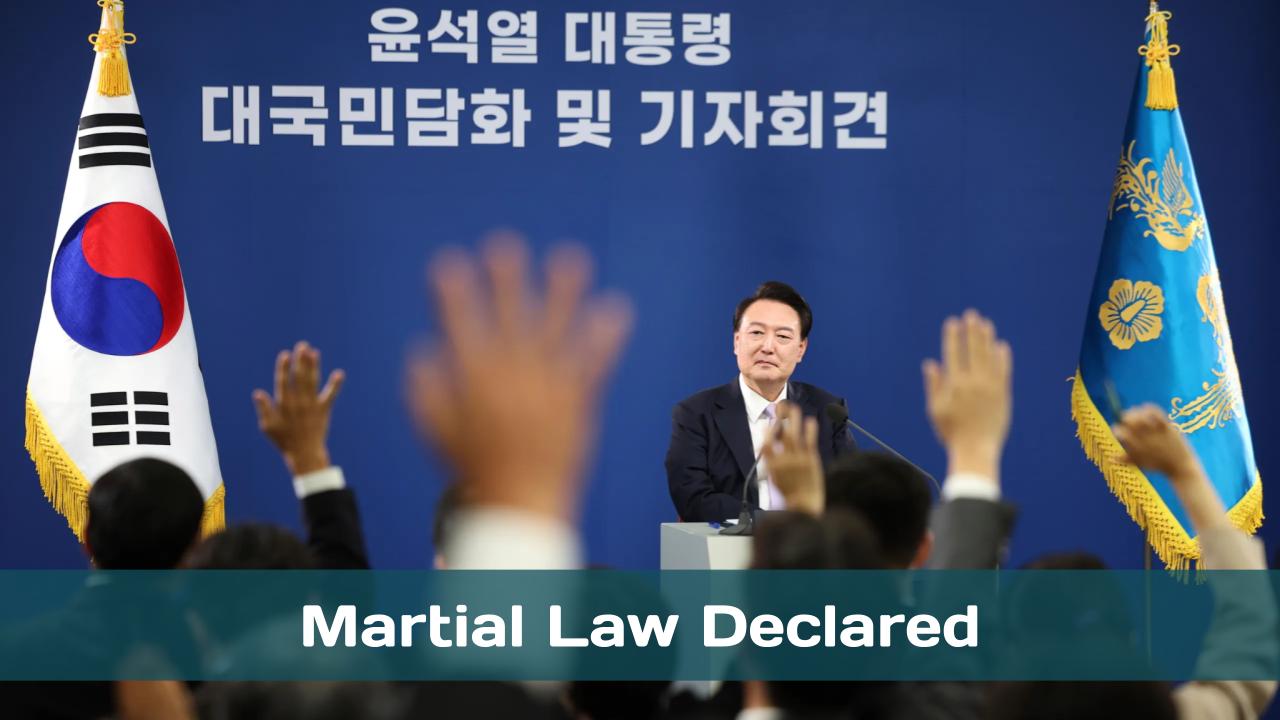
For the first time since South Korea became a democracy some 40 years ago, a president declared martial law.
But hours later, the opposition and members of his own party in parliament rejected the order. Nick Schifrin discussed what led to this undemocratic move by President Yoon Suk Yeol and what’s next for South Korea with Frank Jannuzi.
PBS NewsHour – December 4, 2024
PBS News Hour full episode, Dec. 4, 2024
Supreme Court hears arguments in most significant trans rights case to reach bench
Hegseth returns to Capitol Hill in latest attempt to salvage defense secretary nomination
The bald eagle was never officially named the national bird. That could soon change
Federal Reserve Bank of San Francisco president on latest efforts to tame inflation
Is U.S. investment in Africa coming too late to counter China and Russia on the continent?
Chinese hackers have infiltrated at least 8 U.S. telecom companies, White House says
News Wrap: United Healthcare CEO killed in brazen and targeted attack, New York police say
– December 4, 2024
South Korean President Yoon Suk Yeol said he will lift his martial law order after lawmakers unanimously rejected his decree.
Meet Neo, the AI robot that can do your laundry, make coffee and have a conversation
Pete Hegseth asked about misconduct allegations from time leading veterans charities
– December 4, 2024
South Koreans Must Not Let Their President’s Failed Self-Coup Go to Waste
Quico Toro, Persuasion
A rare opportunity to entrench democracy is at hand
Liberal democracy, it has been said a million times before, is such a dull, procedural affair that it often struggles to rally deep emotional attachment even from its supporters. Crises like the one South Korea has just gone through—moments when the survival of liberal democracy seems in doubt—can sometimes square the circle, renewing people’s commitment to democratic ideals and binding them emotionally to a system that so often errs on the side of limp proceduralism.
Which is why as I saw Koreans pouring into the streets of Seoul last night to reject the president’s power grab, I felt more hopeful than afraid. Their country is going through the kind of crisis that, if courageously handled, can leave a democracy stronger. For their sake and ours, let’s hope they succeed.
Getting mean and dirty only helps Trump
Steve Schmidt, The Warning
Adopting a politics of authentic morality that places a premium on service and people would be a start. It is time to start imagining the future.
Progressives should appreciate their liberation from the defense of 20th century
government programs and departments that Republicans have long attacked as unnecessary, bureaucratic and wasteful. Everything will be gone within four years, and mostly gone in two.
Unless the Democratic Party is fueled by idealism, opportunity and fighting to be on the side of ordinary Americans, it defaults into being the extremely unappealing party: weak, elitist and out-of-touch.
Manufacturing is a war now
Noah Smith, Noahpinion
And the democracies are losing.
And one absolutely essential component of an FPV drone is a battery. In fact, improvements in batteries — along with better magnets for motors and various kinds of computer chips for sensing and control — are what enabled the drone revolution in the first place. And who makes the batteries? That would also be China:
The democratic countries have all struggled to respond to China’s industrial assault, because as capitalist countries, they naturally think about manufacturing mainly in terms of economic efficiency and profits unless a major war is actively in progress
Should parents have the right to make unilateral decisions for their children regarding gender-affirming care?
Yes
No
Could we motivate American 18-year-olds into military service if we needed them to respond to a national security threat?
58.52% – No
41.48% – Yes
*Percentage of 31,306 votes
America’s counties are less purple than they used to be
Showing just red and blue states doesn’t paint an accurate picture of national politics.
How right-wing media is like improv theater
Improv theater is known for improvisation, audience participation and riffing on memes and stories circulating on social and traditional media – all hallmarks of right-wing media.
Is masculine anxiety spurring support for Trump among Gen Z?
What does it mean if young men sense that their masculinity is under threat? Or if they sense a bleak and hopeless future?
PBS NewsHour, December 4, 2024 – 11:00 am to 12:00 pm (ET)
PBS NewsHour, December 4, 2024 – 10:00 am to 11:00 am (ET)
PBS NewsHour, December 4, 2024
Bloomberg Quicktake – December 3, 2024 (01:00)
South Korean President Yoon Suk Yeol declared martial law on Tuesday in an emergency national address televised live as he accused the opposition of trying to paralyze the administration amid a deepening political rift.
Yoon said the decision was made to protect freedom and constitutional order, and that it will not have an impact on South Korea’s foreign policy. He added that it would also help remove North Korea supporters. “Through the declaration of martial law, I will rebuild and protect a free South Korea,” Yoon said.
A proclamation released after the address banned all political activities and strikes and said media would be subject to control of the Martial Law Command, according to Yonhap News.
The National Assembly voted down the decree, but the political crisis isn’t over.
South Korea is in the grip of a political crisis after President Yoon Suk Yeol declared martial law on Tuesday — a shocking move that sparked mass protests and drew sharp rebuke from the country’s parliament.
Though Yoon has said he will reverse his declaration, that’s unlikely to end South Korea’s political problems, which go beyond Tuesday’s emergency.
Yoon first made the declaration during a televised announcement on Tuesday night local time, claiming that the opposition party to his government was in the midst of an “insurgency” and “trying to overthrow the free democracy,” likely in reference to the political deadlock between himself and the parliament that has prevented him from enacting his agenda. Despite that ongoing gridlock, the move to declare martial law took Yoon’s political opponents, allies, the South Korean public — and the world — by surprise.
South Korea and America
First of all, we have to take in a very basic reality: that attempts to establish military dictatorships have been made in democracies, and will be made in other democracies –including, very possibly, in the American one.
Those instincts led South Koreans, en masse, to ignore the declaration of martial law, and to do the very things that their president tried to forbid them to do: speak, gather, resist.
Would Americans take a similar stand? Thanks to South Koreans in the last hours, and thanks to many other examples around the world, contemporary and historical, we can know the danger signs, and we can make preparations. Others have given us time to think, and have set for us good examples. We will have no excuses.
Guardian, – December 3, 2024
Rightwing president backs down after most serious challenge to country’s democracy since 1980s
South Korea’s rightwing president has been forced to back down after he unexpectedly declared martial law only to face unanimous opposition from the national assembly, in the most serious challenge to the country’s democracy since the 1980s.
President Yoon Suk Yeol declared martial law late on Tuesday amid a dispute with opposition parties he accused of pro-North Korean sympathies and anti-state activities.
But after some of the tensest hours in the country’s recent history, Yoon said troops would return to their barracks and the order would be lifted following a cabinet meeting.
The US onAir Network supports US citizens and democracy by bringing together information, experts, organizations, policy makers, and the public to facilitate greater engagement in federal, state, and local politics and more civil, positive discussions and collaborations on important issues and governance.
The US onAir Network has a national hub at us.onair.cc and 50 state onAir hubs. To learn more about the US onAir Network, go to this post.
ABOUT US ONAIR NEWS
The first news items on US issues, government, and politics will start being displayed on the US onAir homepage around 9 am. Throughout the day, livestreamed events will appear under the “Latest” tab. The last news items will appear around 9 pm concluding with PBS NewsHour’s full episode with links to each video clip within the hour show. Go to the Free News Platforms post to learn more where we draw most of our US onAir news content and how to find previous daily news posts.
US ONAIR SUBSTACK
US onAir has established a substack at usonair.substack.com to provide substack subscribers a way to receive these news posts within a phone app and via email. Comments on news items can be made in the substack post. OnAir members can comment in this onAir post and/or in specific related onAir posts. Substack posts are delivered by email around 9pm Monday thru Friday.