Summary
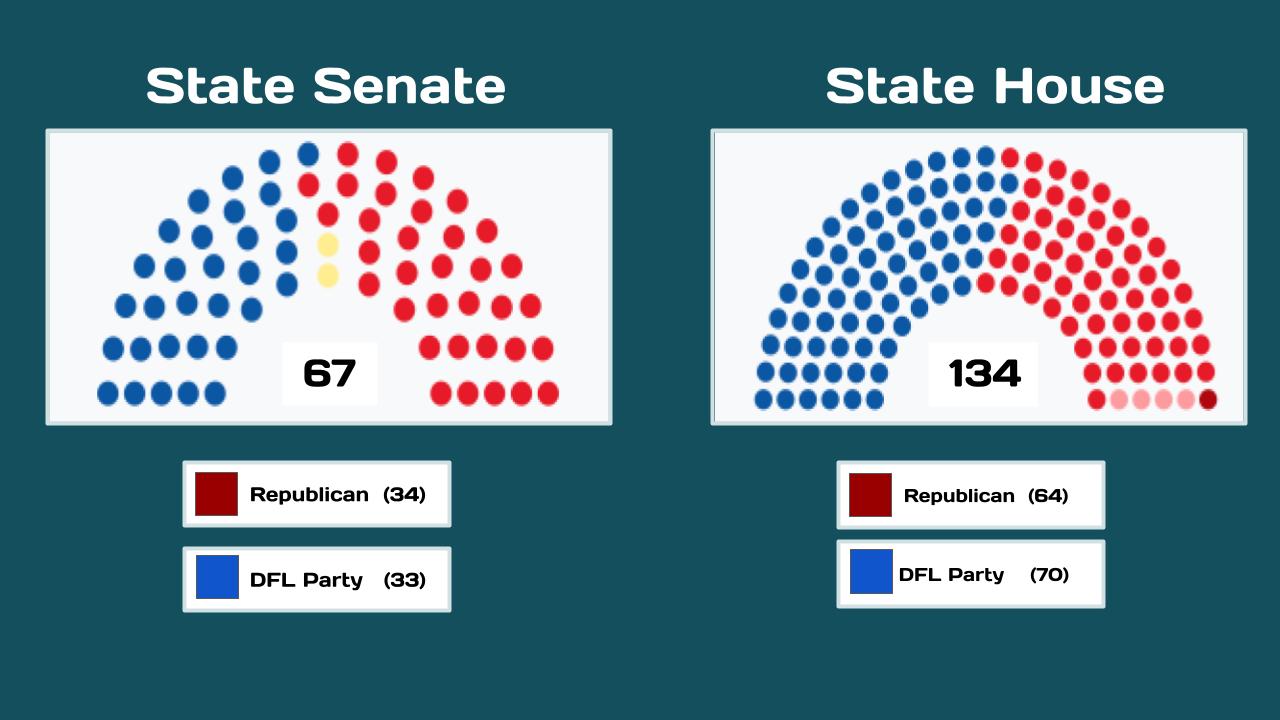
The Minnesota Legislature is the bicameral legislature of the U.S. state of Minnesota consisting of two houses: the Senate and the House of Representatives. Senators are elected from 67 single-member districts. In order to account for decennial redistricting, members run for one two-year term and two four-year terms each decade. They are elected for four-year terms in years ending in 2 and 6, and for two-year terms in years ending in 0. Representatives are elected for two-year terms from 134 single-member districts formed by dividing the 67 senate districts in half. It is the only state legislature in the country to be split with the Republicans controlling the state senate and the democrats controlling the state house.
Both houses of the Legislature meet between January and the first Monday following the third Saturday in May each year, not to exceed 120 legislative days per biennium. Floor sessions are held in the Minnesota State Capitol in Saint Paul.
OnAir Post: MN Legislature
News
Minnesota Reformer, – September 2, 2021
Senate Minority Leader Susan Kent, DFL-Woodbury, announced Thursday she would step down as caucus leader and will not seek reelection in her suburban Senate district.
Kent, who was first elected in 2012, was the first woman to lead the Senate DFL caucus when she ousted state Sen. Tom Bakk for the job in February 2020.
In a statement, she cited the stress and the toll the pandemic has taken on her and her family.
Minnesota Reformer, – May 25, 2021
Instead, lawmakers adjourned on Monday announcing only a broad “numbers-only” budget that still needs to be crafted and passed by June 30 or force the state into a partial government shutdown.
Faced with an $883 million budget deficit, a state in the middle of the COVID-19 pandemic and uncertainty around a federal government bailout, Minnesota leaders were ready to fight over potential cuts to state government and perhaps new tax increases.
Reformer Radio · The chaotic and unproductive 2021 session
Legislative leaders effectively extended their own deadline, buying just two more weeks to finish their work but still claimed victory despite the billions of dollars still left to appropriate.
About
Source: Wikipedia
History
Early on in the Minnesota’s history, the Legislature had direct control over the city charters that set the groundwork for governments in municipalities across the state. In the early period, many laws were written for specific cities. The practice was outlawed in 1881, though attempts were still made. For instance, the long-standing Minneapolis Park and Recreation Board and the city’s now defunct Library Board were both created by the Legislature in the next several years. The Minnesota Constitution was amended in 1896 to give cities direct control over their own charters.
Following the ratification of the Nineteenth Amendment to the United States Constitution in 1920, women began to be elected to the Minnesota Legislature. In 1922, Mabeth Hurd Paige, Hannah Kempfer, Sue Metzger Dickey Hough and Myrtle Cain were elected to the Minnesota House of Representatives.
In 1984, the Legislature ordered that all gender-specific pronouns be removed from the state laws. After two years of work, the rewritten laws were adopted. Only 301 of 20,000 pronouns were feminine. “His” was changed 10,000 times and “he” was changed 6,000 times.
The non-partisan era
In 1913, Minnesota legislators began to be elected on nonpartisan ballots. This was a historical accident that occurred when a bill to provide for no-party elections of judges, city, and county officers was amended to include the Legislature in the belief that it would kill the bill. While Minnesota legislators were elected on a nonpartisan ballot, they caucused as “Liberals” or “Conservatives,” roughly the equivalent in most years to Democratic or Farmer–Labor (later Democratic–Farmer–Labor) and Republican, respectively. In 1974, House members again ran with party designation. In 1976, Senate members again ran with party designation.
Recent history
Governor Jesse Ventura advocated the idea of changing the Legislature to be unicameral while he was in office, but the concept did not obtain widespread support.
In 2004, the Legislature ended its regular session without acting on a majority of the planned legislation, largely due to political divisiveness on a variety of issues ranging from education to same-sex marriage (See same-sex marriage in the United States for related events during the year). A proper budget failed to pass, and major anticipated projects such as the Northstar Corridor commuter rail line were not approved. Governor Tim Pawlenty, an advocate of the line (formerly an opponent), was expected to request a special session, but ended up helping the coordination of other funds to continue development of the line. The lack of action in the 2004 session is said to be one reason why a number of Republican House members lost their seats in the November election. The Democratic–Farmer–Labor (DFL) minority grew from 53 to 66 and the Republican majority was reduced from 81 to 68.
The Senate was not up for election in 2004 so the DFL was able to maintain its five-seat majority in the upper house. One state senator, Sheila Kiscaden of Rochester, was an Independence Party member until December 2005 when she began caucusing with the DFL, although she had been an elected Republican in the past. The DFL majority increased to six senators when Kiscaden announced her re-affiliation with the DFL in preparation to run for lieutenant governor on a ticket with DFLer Kelly Doran.
There is a mandatory adjournment date specified in the state constitution: “The legislature shall not meet in regular session, nor in any adjournment thereof, after the first Monday following the third Saturday in May of any year.” In 2005, the regular session ended without passage of an overall budget and a special session was subsequently called by Governor Pawlenty. No overall budget passed by the end of the fiscal year on June 30, and much of the government shut down for the first time in the state’s history. However, some essential services remained in operation and some departments received funding in legislation. A compromise budget was approved and signed into law two weeks later.
As of 2018, it is one of two state legislatures under split control, along with Alaska.
Television broadcasts
When the Legislature is in session, proceedings of both houses are broadcast on television via the Minnesota Channel and also online via the Legislature’s website.
See also
Wikipedia


 |
|---|
| Constitution |

The Minnesota Legislature is the bicameral legislature of the U.S. state of Minnesota, composed of a Senate and a House of Representatives. The legislature originally met at the old Territorial Capitol in Saint Paul and now convenes at the Minnesota State Capitol. The Senate consists of 67 seats, the House 134 seats and the legislators serve without term limits.
The legislature meets between January and the first Monday following the third Saturday in May each year, not to exceed 120 legislative days per biennium. Floor sessions are held in the Minnesota State Capitol in Saint Paul.
In the 94th Legislature (2025–2026) the Democratic-Farmer-Labor (DFL) Party controls the Senate with 34 of the 67 seats and the House evenly split between the DFL and Republicans, with both parties holding 67 of the 134 seats.[1][2]
History
Territorial status
Portions of the area that would become the State of Minnesota have been part of the United States since the Treaty of Paris 1783 established the boundaries of the newly independent nation. In 1787, the region was organized under the control of the expansive Northwest Territory, but portions of this region were in dispute with British North America until 1818. The Louisiana Purchase in 1803 brought in the remainder of the territory into the control of the US. Over the next few decades the area would be organized under the Indiana, Illinois, Michigan, Missouri, Wisconsin, and Iowa territories. Due to the lack of European settlement the exact boundaries of the region was not a major concern. Following the statehood of Iowa in 1846 and Wisconsin in 1848, there was a desire for reorganization centered around the remaining unorganized populace which was based in St. Croix County. Settlers held a convention in Stillwater and passed resolutions to congress calling for the establishment of a new territory. This request was granted with the creation of the Minnesota Territory on March 3, 1849. St. Paul was selected as the territorial capitol, the University of Minnesota was placed in Minneapolis, and the Territorial Prison in Stillwater. Alexander Ramsey was appointed as the first territorial governor. The territorial legislature organized with 18 members of the House of Representatives and 9 members of the Territorial Council.
Policy involving the native population of the territory were a focus of the territory. Minnesota was rare in that mixed race native persons were explicitly granted citizenship and allowed to participate in the political process.[3] In 1851 the legislature oversaw the major land cession of native tribes through the treaties of Mendota and Traverse des Sioux which opened up the southern half of the territory to white settlement.[4]
The territory also highlighted national debates on slavery as it served as the setting for the Dred Scott v. Sandford supreme court case as Scott, an enslaved person, had been brought into the non-slaveholding territory by his owners, and lived there for several years.
Establishment and early statehood
The population of the territory grew rapidly from around 6,000 in 1849 to over 120,000 over the next decade.[5] The growing population and the debate around a transcontinental railroad brought the issue of statehood to the fore.[6] National sectionalist debates over the issue of slavery made the admission of the state highly contentious, but it was decided that Minnesota would be admitted as a free state helping to disrupt the balance between slave and free states which had existed previously. A constitutional convention began in 1857, but internal partisan divisions between the Democratic and Republican parties resulted in delegates from each party writing separate constitutions. The two documents were nearly identical with only minor differences in punctuation and grammar.[7] The joint documents were approved by popular vote, but the territorial secretary, who was a Democrat, sent that copy to Congress for approval. However, there is evidence that Congress was able to view both versions as they sent the copy of the Republican version back with the enacting legislation.[8] Minnesota was granted statehood on May 11, 1858.
The state legislature convened prior to the ratification of their constitution by Congress with 80 members of the House of Representatives and 37 Senators. The first regular session lasted 254 days, which still ranks as the longest of any meeting, and was so long that it was determined that it was not necessary for the legislature to meet for a year following the 1858 election.[9] The size of the legislature was soon decreased; by 1861 the House had 42 members and the Senate had 21.[10] Representatives served a one-year term, Senators served two year terms with elections being staggered so that half the body was elected every year.[11]
During the Civil War, Minnesota contributed several regiments to support the Union, including the 1st Minnesota Infantry which famously captured a Confederate battle flag during the Battle of Gettysburg, which has remained in possession of the despite multiple requests from Virginia to return it.[12] While the state was far from the frontlines of the war, it did not escape conflict because in 1862 the Dakota War took place. As a result of the war the protections on native voting rights were removed and some reservations were abolished.[13]
Following the Civil War and start of Reconstruction, Minnesota was an early leader on African American civil rights. In 1868, African American men were granted the right to vote (two years before the adoption of the 15th amendment), and in 1869 the legislature banned segregation in state schools. In 1885, the legislature expanded this protection by prohibiting segregation in all public accommodations.[14][15]
Early in Minnesota's statehood, the legislature had direct control over the city charters that set the groundwork for governments in municipalities across the state. In the early period, many laws were written for specific cities. The practice was outlawed in 1881, though attempts to enact municipal legislation were still made.[16] For instance, the long-standing Minneapolis Park and Recreation Board and the city's now defunct Library Board were both created by the legislature in the next several years.[17][18] The Minnesota Constitution was amended in 1896 to give cities direct control over their own charters.[16]
In 1898, the legislative process for amending the state constitution changed. Prior to this point after receiving majority votes in both chambers it had to be ratified by a simple majority in the next general election. After this point, the requirement changed to require a majority of all voters in the election to approve, not just those voting on the question. Meaning that voting "no" and not voting on the amendment now can produce different results, and amendments which have a majority "yes" votes can still fail if they don't meet the threshold of a majority of the total votes.[19]
In 1860, the legislature set a limit of 60 days on their annual legislative session. Starting in 1879, the legislature shifted to a biennial calendar in which they would meet only in odd numbered years. By 1889, the length of the session was extend 90 legislative days.[9] The 1879 legislature also saw the length of members terms be extended to two years for representatives and four years for senators, with the entire body being up for election at the same time.[19][11] This era was marked by Republican dominance in the legislature and notable figures from the time include: Ignatius Donnelly (Lieutenant governor, 1860–1863, and congressman, 1863–1869), John S. Pillsbury (Governor, 1876–1882), William R. Merriam (Speaker of the House, 1887–1889, and Governor, 1889–1893), and John Francis Wheaton (State Rep., 1899–1900) who was the first African American elected to the legislature. The legislature moved into the current State Capitol in 1905.
The nonpartisan era
Beginning in 1913 Minnesota became the first state to elect their legislators on a nonpartisan basis. This was a historical accident that occurred when a bill to provide for nonpartisan elections of judges, city, and county officers was amended to include the legislature in the belief that it would kill the bill.[20] While Minnesota legislators were elected on a nonpartisan ballot, they caucused as "Liberals" or "Conservatives," roughly the equivalent to national political parties.[21] During this period conventions began developing such has defined rolls for majority and minority caucus leaders. In 1901, Winslow W. Dunn was selected as the first majority leader of the house and he was followed in 1933 by Charles N. Orr for the senate.[22][23] While the legislature was nonpartisan, statewide and congressional seats still carried partisan labels. The state was notable for the success of populist third parties. In 1891, Ezra T. Champlin of the Farmers’ Alliance, a predecessor of the People's Party, was selected as Speaker of the House. Prior to the adoption of non-partisan legislatures the body consistently had members of the Populists, Socialists, and Prohibition parties. The state also voted for the Bull Moose Party in the 1912 presidential election. In 1915 the Nonpartisan League was established in neighboring North Dakota and by 1917 it had expanded into the state.[24][25] The Nonpartisan League soon merged with local political groups and formed the Farmer-Labor Party. The party started to gain traction in 1922 with the election of Henrik Shipstead and Magnus Johnson to the US Senate. The party garnered even greater success during the Great Depression with a radical platform focused on addressing the economic situation. In 1930, Floyd B. Olsen was elected as Governor and became a very influential figure in the history of the state. In 1944, the Farmer-Labor Party officially merged with the state's Democratic Party to form the Democratic-Farmer-Labor (DFL) Party.
A defining attribute of the legislature at the time involved the issue of legislative redistricting. Following the 1910 census, the legislature drew new maps for the congressional and state legislative districts in 1913, the senate was expanded of 67 members and the House to 130 members.[10] After the state supreme court upheld the boundaries, the legislature chose not to alter these boundaries following subsequent censuses. Between 1913 and 1962, the boundaries for state legislative districts did not change, and the boundaries for congressional districts changed only once following the 1930 census due to the state losing the 10th congressional district in national reapportionment. The legislature passed a new map in 1931, but Governor Floyd B. Olsen vetoed the maps and the issue ultimately went to the supreme court in the case Smiley v. Holm. Due to a delay in the drawing of districts caused by the court case, the state's representatives to congress in 1932 were elected statewide.[26] In 1959, a panel of federal judges ruled that the state legislative districts were unconstitutional due to the vast population differences and ordered the lines be redrawn effective in 1962. These new maps were overturned in 1964 following the application of the landmark Supreme Court case Baker v. Carr which established the principle of “One person, one vote”. State maps continued to be argued and redrawn, including a proposal that would have reduced the legislature to 35 senators and 105 House districts, until 1972 decision by the Supreme Court set the legislature at its current size of 67 senators and 134 House seats and that each district could only vary in population size by 1.8%.[27] In 1962, the legislative session was extended to 120 days.[9]
Though the Conservative caucus maintained control over the legislature for the majority of this period, Minnesota legislature was an early advocate of many of the issues dominating the Progressive Era.[24] In 1911, the state became the fourth in the nation to abolish the death penalty. The following year it was the third state to ratify the 17th Amendment to the Constitution providing for the direct election of United States Senators. In 1919, the legislature voted to ratify the 18th Amendment to the Constitution prohibiting the sale of alcohol the day after it had secured the necessary number of states to become law. Minnesota Congressman Andrew J. Volstead strongly supported the passage of the enacting legislation enforcing the amendment through Congress and his name became associated with the bill. On the issue of women's suffrage, Minnesota passed legislation the same year allowing for women to vote in presidential elections. Later in the year, a special session was called in which they voted to ratify the 19th Amendment to the Constitution. The first four women in the legislature joined the state House of Representatives in 1923: Mabeth Hurd Paige, Hannah Kempfer, Sue Metzger Dickey Hough, and Myrtle Cain.[28] The first woman in the state senate, Laura Emelia Naplin joined the body in 1927.
On issues of civil rights, the citizenship of Native Americans in the state were restored with the passage of the federal Indian Citizenship Act of 1924. In 1921, following the high-profile lynching of three men in Duluth the legislature made lynching a felony even as similar legislation failed at a national level.[29] In 1953, the legislature outlawed racial covenants in zoning laws after the Supreme court struck them down as unconstitutional.[30] At the height of the Civil Rights movement in 1967, the legislature passed a comprehensive law protecting people regardless of race, color, creed or national origin in from discrimination in accommodations, education, employment, public services, or union membership. The law would become known as the Minnesota Human Rights Act and would go on to be amended multiple times to include other protected classes such as sex, marital status, disability, and sexual orientation.[15][31]
Legislative reforms and Modernization
The 1970s saw Minnesota go through a process of significant changes to the political structure of the state. Following the culmination of the redistricting debate in 1972, the requirement for nonpartisan elections were removed for subsequent elections of the legislators, starting in 1974 for the House of Representatives followed by the Senate two years later.[1][2] In 1971, the legislature created a commission to study the state constitution to determine if there were any necessary amendments and to modernize any antiquated language, the revised constitution was adopted in 1974. In 1972, the lieutenant governor was changed from an office elected in their own right to being jointly elected with the governor and they were removed from the position as president of the Senate. The calendar of legislative sessions was also changed to its current form, the regular sessions can take place annually between the January and May every year, but they cannot meet for more than 120 legislative days over the biennium.[19]
A notable piece of legislation from this period was the so-called “Minnesota Miracle of 1971”. The legislation pushed by Governor Wendell Anderson restructured the tax collection and proportion of state funding provided to state public schools in order to provide financial security for the school districts while also lowering property taxes.[32][33]
Notable membership from this period include B. Robert Lewis who became the first African American man elected to the state senate in 1972.[34] In 1974, fellow state senator Allan Spear came out as one of the first openly gay elected officials in the country. He served in the body for nearly 30 years and in 1993 was elected President of the Minnesota Senate.[35]
In 1979, Republican Representative Robert Pavlak was removed from the House near the end of the session after the State Supreme Court found him guilty of unfair campaign practices in the previous election. The House had been evenly split 67-67 during the session and a tenuous power sharing agreement had been formed to allow the chamber to operate smoothly. Pavlak, per House Rules, was unable to vote on the matter and the motion to declare his seat vacant passed on a party line vote 67–66. Republicans argued that the vote was unconstitutional because it required a two-thirds majority to expel a member, DFLers argued that they were not expelling Pavlak, but were vacating the election returns which only required a majority vote. In the special election to fill the vacancy Pavlak lost to DFL candidate Frank Rodriguez Sr. thus cementing DFL leadership for the remainder of the session.[36]
In 1984, the legislature ordered that gender-specific pronouns be removed from state laws. After two years of work, the rewritten laws were adopted.[37] In the state laws, only 301 of 20,000 pronouns were feminine. "His" was changed 10,000 times and "he" was changed 6,000 times.[38]
Recent history
Former professional wrestler Jesse Ventura won the 1998 gubernatorial election under the banner of the newly formed Reform Party. He did not have a political party base in the legislature, and he later advocated the idea of changing the legislature to be unicameral, but the concept did not obtain widespread support.[39]
In 2001, newly elected Representative Neva Walker made history as the first African American woman to serve in the Minnesota legislature.[40]
In 2004, the legislature ended its regular session without acting on a majority of the planned legislation, largely due to political divisiveness on a variety of issues ranging from education to same-sex marriage (See same-sex marriage in the United States for related events during the year). A proper budget failed to pass, and major anticipated projects such as the Northstar Corridor commuter rail line were not approved.[41] Governor Tim Pawlenty, an opponent turned advocate of the line, was expected to request a special session but ended up helping the coordination of other funds to continue the development of the line.[42] The lack of action in the 2004 session is said to be one reason why a number of Republican House members lost their seats in the November election. The Democratic–Farmer–Labor (DFL) minority grew from 53 to 66 and the Republican majority was reduced from 81 to 68.[43]
The Senate was not up for election in 2004 so the DFL was able to maintain its five-seat majority in the upper house. One state senator, Sheila Kiscaden of Rochester, was an Independence Party member until December 2005 when she began caucusing with the DFL, although she had been an elected Republican in the past. The DFL majority increased to six senators when Kiscaden announced her re-affiliation with the DFL in preparation to run for lieutenant governor on a ticket with DFLer Kelly Doran.[44]
2005 shutdown
There is a mandatory adjournment date specified in the state constitution: "The legislature shall not meet in regular session, nor in any adjournment thereof, after the first Monday following the third Saturday in May of any year." In 2005, the regular session ended without passage of an overall budget and a special session was subsequently called by Governor Pawlenty.[45] No overall budget passed by the end of the fiscal year on June 30, and much of the government shut down for the first time in the state's history. However, some essential services remained in operation and some departments received funding in legislation.[46] A compromise budget was approved and signed into law two weeks later.[47]
2011 shutdown

The 2011 Minnesota state government shutdown was a government shutdown affecting the U.S. state of Minnesota. The shutdown was the result of a fiscal dispute between the Democratic–Farmer–Labor Party (DFL) Governor Mark Dayton and the Republican-majority Minnesota Legislature, that was not resolved by the constitutional deadline on June 30. The Republican caucuses and their leaders demanded bigger spending cuts, and for the budget shortfall to be met without tax increases, while Dayton demanded some tax increases. The shutdown started at midnight on July 1, and ended after a budget bill was passed and signed on July 20.
During the shutdown all less important parts of the state government, that were not identified as critical services before the shutdown or in several court cases, suspended their operations. Most state government services were identified as critical or otherwise allowed to continue, so as much as 80 percent of state government spending continued. The eventual budget agreement started to form after Governor Dayton announced on July 14 that he would "reluctantly" pass the last proposal of the Republican legislative leadership before the shutdown, but with conditions. The shutdown was disruptive to the government and some Minnesotans, but its ultimate economic impact was minimal. Politically, it could have influenced the Republican electoral defeat in the 2012 state elections, although there were other factors that may have been more important.
2020s
The 2022 general election saw the DFL maintain the governorship and the state House, while regaining control of the state Senate by a single seat. This produced the first DFL legislative trifecta since 2014. The DFL used this trifecta to push through a plethora of legislation in what Governor Tim Walz claimed was the "most productive session in Minnesota history".[48] Legislation passed included codifying abortion rights, universal free school meals, mandating paid leave, and legalizing recreational cannabis. This session also marked the first time Black women served in the State Senate with Zaynab Mohamed, Erin Maye Quade, and Clare Oumou Verbeten. Quade and Verbeten are also the first openly LGBTQ women to serve in the senate.[49][50] https://www.politico.com/news/2025/02/26/lisa-demuth-minnesota-house-speaker-interview-00205445
The results of the 2024 election left the Minnesota House tied with 67 members elected from each major party, only the second time in history this has occurred. During negotiations for a power sharing agreement, the results of two races faced legal challenges. The election of DFLer Curtis Johnson was nullified due to a residency challenge, requiring a special election.[51] Another race, between DFL Brad Tabke and Republican Aaron Paul had shown the a number of ballots had gone missing due to human error and a recount had shown the margin between candidates was only 15 votes, however the call for a special election in this case was denied. The results of these lawsuits resulted in Republicans gaining a temporary legislative majority. Governor Walz called for a special election to be held in January 2025 in order to minimize the amount of time Republicans would have the majority, but the state supreme court ruled that he issued the call prematurely.[52][53] The power sharing negotiations broke down and the 2025 session began with a stalemate as the DFL members boycotted the opening day of session, denying quorum. Republicans met anyways, arguing that the vacany changed the number required to meet quorum and elected Representative Lisa Demuth as Speaker of the House.[54] The State Supreme Court ultimately agreed that quorum had not been achieved and as such the Demuth's election as Speaker was invalid. After three weeks of negotiations a power sharing agreement was reached in which Demuth would retain the title of Speaker.[55][56] Demuth also has the distinction of becoming the first Black person to lead the chamber.[57]
The 2025 shootings of Minnesota legislators on June 14 resulted in the death of Representative and former Speaker Melissa Hortman and wounding of Senator John Hoffman, both members of the DFL.[58]
Qualification and terms
The Senate currently has 67 seats and the House has 134 seats, each Senate district is split between an A and B House district (e.g., Senate District 1 contains House districts 1A and 1B). The Minnesota Constitution forbids House districts that are within more than one Senate district.
To serve in the legislature a member must be at least 21 years of age and be eligible to vote in the state. They must also have resided in Minnesota for at least a year and in the district for at least six months prior to their election.[59]
Representatives are elected to two-year terms. Senators are elected to four-year terms in years ending in 2 and 6 and two-year terms in years ending in 0, unlike the United States Senate which staggers the election of their membership, the entirety of the Minnesota Senate goes up for election every time. There are no term limits.
Legislative process
The legislature meets between January and the first Monday following the third Saturday in May each year, not to exceed 120 legislative days per biennium. Since 2025, a legislative day is defined as a day in which a bill passes a third reading, a rule is adopted, or some other legislative task such as the confirmation of an appointment or the overriding of a veto. The governor can call special sessions of the legislature outside of the normal schedule.[60] During a special session the legislature can only debate and vote on legislation prescribed in the governor’s call, but there is no time limit on how long the special session can last. While most special sessions only last a few days, the longest took place from May through October of 1971.[61]
A majority of members in each chamber are required to make quorum.[62]
The Minnesota constitution spells out certain limitations on the legislation that can be passed by the legislature, such as all bills for raising revenue must originate in the House of Representatives, general banking laws require a 2/3rd supermajority to pass, no legislation can be passed on the final day of a legislative session, and the content of legislation is restricted to a single subject.[62]
At the start of each session, each chamber is responsible for electing their own leadership. In the House this includes the Speaker and since 1972 in the Senate this is the president of the senate. The speaker and president are responsible for ruling on point of order, recognizing members for debate, and assigning legislation to different committees.
If a member wishes to introduce a bill, the member works with the Office of the Reviser of Statutes in order to ensure the content of the bill complies with legal standards. After the bill is prepared they submit it to the chamber leadership who will then introduce the bill on the floor and assign it to a committee.[63]
Committees play an important role in the legislative process as essentially all legislation must go through them. Membership of the committees is split proportionally between the majority and minority parties with the party proposing their own lists of appointees to the committee. Standing committees also have the ability to introduce bills as if they were a bill author. The committees debate bills and recommend its passage or rejection by the full body.
In the House after a bill is passed out of committee it is placed in the “General Register” until it is placed on the “Calendar of the Day” by the Committee on Rules and Legislative Administration. Once a bill is on the Calendar of the Day it must be considered, but the order in which bills on the calendar are considered is determined by the Speaker. During this time a bill can be debated and amended after which it is immediately put before the body for a final vote. The House also has a “Fiscal Calendar” created by the Ways and Means Committee or Taxes Committee for bills that fall under their purview.[64]
In the Senate after a bill is passed out of committee it goes before a “Committee of the Whole” where it is debated and amended before it is placed on the daily Calendar for a final vote.[65]
If the two chambers pass different versions of the same bill, then a conference committee is formed of equal numbers of members from each chamber who will work out the differences between the legislation. The conference committee will issue a report which will then go back in front of each chamber for another vote on whether to accept any amendments.
If a bill is passed during session the governor has three days to veto the law. If a bill is passed within the final three days of the session, then the governor has 14 days to veto. The governor, unlike the US president, has the ability to use a “line-item veto” on individual aspects of appropriation bills. The legislature can over turn a veto with a 2/3rds majority vote in both chambers. If the governor does not sign the bill after three days it still becomes law, unless the bill was passed within the final three days of the session, in which case the bill does not become law if they do not sign it before the end of the 14 day period.[63]
Television broadcasts
When the legislature is in session, proceedings of both houses are broadcast on television via the Minnesota Channel and also online via the legislature's website. The Minnesota House YouTube channel is "MNHouseInfo". The Minnesota Senate YouTube Channel is "Minnesota Senate Media Services".
Compensation
Prior to 2016, the salaries of Minnesota legislators were prescribed by law. After the passage of a constitutional amendment, a Legislative Salary Council, made up of members appointed by the governor and the chief justice of the Supreme Court, determines the compensation of the members.[66]
As of 2025, the annual salary of a member is set at $51,750, along with lodging reimbursements and per diems. Leadership positions are also eligible for higher pay.[66]
Gallery
![The State Office Building, where members of the Minnesota House of Representatives have offices, adjacent to the Capitol. Currently under renovation[67]](https://upload.wikimedia.org/wikipedia/commons/thumb/8/8d/State_Office_Building_%28S.O.B.%29_seen_from_near_the_front_steps_of_the_State_Capitol_on_Aurora_Avenue_in_Saint_Paul%2C_Minnesota.jpg/330px-State_Office_Building_%28S.O.B.%29_seen_from_near_the_front_steps_of_the_State_Capitol_on_Aurora_Avenue_in_Saint_Paul%2C_Minnesota.jpg) The State Office Building, where members of the Minnesota House of Representatives have offices, adjacent to the Capitol. Currently under renovation[67]
The State Office Building, where members of the Minnesota House of Representatives have offices, adjacent to the Capitol. Currently under renovation[67]![The State Office Building, under construction. It is scheduled to re-open in 2027.[68][69] 166,000 square feet will be added.[70]](https://upload.wikimedia.org/wikipedia/commons/thumb/8/8d/State_Office_Building_construction_%28cropped%29.jpg/330px-State_Office_Building_construction_%28cropped%29.jpg)
 Minnesota Senate Building, completed 2015, where members of the Minnesota Senate have offices and hold hearings. Connected to the capitol by tunnel
 Members of both houses of the 94th Minnesota Legislature in the House chambers, during the State of the State address in 2025
![The State Office Building, where members of the Minnesota House of Representatives have offices, adjacent to the Capitol. Currently under renovation[67]](https://en.wikipedia.org/wiki/File:State_Office_Building_(S.O.B.)_seen_from_near_the_front_steps_of_the_State_Capitol_on_Aurora_Avenue_in_Saint_Paul,_Minnesota.jpg)
![The State Office Building, under construction. It is scheduled to re-open in 2027.[68][69] 166,000 square feet will be added.[70]](https://en.wikipedia.org/wiki/File:State_Office_Building_construction_(cropped).jpg)

.jpg)
See also
Notes
References
- ^ a b "Party Control of the Minnesota House of Representatives - Minnesota Legislative Reference Library". www.lrl.mn.gov. Retrieved February 11, 2026.
- ^ a b "Party Control of the Minnesota Senate - Minnesota Legislative Reference Library". www.lrl.mn.gov. Retrieved February 11, 2026.
- ^ Sweet, Jameson (2019). "Native Suffrage: Race, Citizenship, and Dakota Indians in the Upper Midwest". Journal of the Early Republic. 39 (1): 99–109. ISSN 1553-0620.
- ^ Murray, W.P. (November 14, 1904). "Recollections of early territorial days and legislation" (PDF). Library of Congress.
- ^ "Minnesotian". www.mnhs.org. Retrieved February 13, 2026.
- ^ Risjord, Norman K. (2005). A Popular History of Minnesota. Saint Paul, MN: Minnesota Historical Society Press. pp. 76–77. ISBN 0-87351-532-3.
- ^ "Minnesota Constitution(s) Home Page". mnhs.gitlab.io. Retrieved February 13, 2026.
- ^ "Minnesota Secretary of State - History/Old Stuff". www.sos.state.mn.us. Archived from the original on May 15, 2008. Retrieved February 13, 2026.
- ^ a b c "Sessions of the Minnesota State Legislature and the Minnesota Territorial Legislature, 1849-present - Minnesota Legislative Reference Library". www.lrl.mn.gov. Retrieved February 13, 2026.
- ^ a b "Number of Legislative Seats - Minnesota Legislative Reference Library". www.lrl.mn.gov. Retrieved February 13, 2026.
- ^ a b Libraries, University of Minnesota. "Minnesota Historical Election Archive". Minnesota Historical Election Archive. Retrieved February 13, 2026.
- ^ Beeland, Harper. "Twenty-eighth Virginia Infantry Regimental Battle Flag | MNopedia". www.mnhs.org. Retrieved February 13, 2026.
- ^ Reicher, Matt. "Ho-Chunk and Blue Earth, 1855–1863 | MNopedia". www.mnhs.org. Retrieved February 13, 2026.
- ^ "Segregated Student Housing and the Activists Who Defeated It : A Campus Divided". Retrieved February 13, 2026.
- ^ a b Orfield, Myron; Stancil, Will (February 2022). "Neo-Segregation in Minnesota". scholarship.law.umn.edu. Retrieved February 13, 2026.
- ^ a b Anderson, William (1922). City Charter Making in Minnesota. Minneapolis: University of Minnesota.
- ^ "History of MPRB". Minneapolis Park and Recreation Board. Archived from the original on March 2, 2014. Retrieved March 2, 2014.
- ^ "Laws of Minnesota 1885, chapter 3" (PDF). Office of the Revisor of Statutes. Retrieved March 2, 2014.
- ^ a b c "Constitutional Amendments - Minnesota Legislative Reference Library". www.lrl.mn.gov. Retrieved February 13, 2026.
- ^ Adrian, Charles R. (Winter 1952). "The Origin of Minnesota's Nonpartisan Legislature" (PDF). Minnesota Historical Society. Retrieved March 2, 2014.
- ^ [1] For example, John J. McNulty was elected to 10 consecutive two-year terms in the Minnesota House of Representatives from 1928 to 1946 on a nonpartisan ballot, while caucusing with the "Liberals" in the House. He died in office in his 19th year as a "Liberal" causer, shortly, after being sworn in for his 10th term. Official website of the Minnesota Legislature.
- ^ "Senate majority and minority leaders, 1933- present - Minnesota Legislative Reference Library". www.lrl.mn.gov. Retrieved February 17, 2026.
- ^ "House majority and minority leaders, 1901-present - Minnesota Legislative Reference Library". www.lrl.mn.gov. Retrieved February 17, 2026.
- ^ a b Backerud, Thomas K. "Progressive Era in Minnesota, 1899–1920 | MNopedia". www.mnhs.org. Retrieved February 17, 2026.
- ^ DeCarlo, Peter J. "Nonpartisan League | MNopedia". www.mnhs.org. Retrieved February 23, 2026.
- ^ Black, Eric (January 24, 2018). "The extraordinary election of '32: How Minnesota Republicans' gerrymandering backfired". MinnPost. Retrieved February 17, 2026.
- ^ Nelson, Paul. "Legislative Redistricting, 1959–1993 | MNopedia". www.mnhs.org. Retrieved February 17, 2026.
- ^ "Women Wielding Power: Pioneer Female State Legislators". National Women's History Museum. Archived from the original on June 4, 2011. Retrieved March 29, 2012.
- ^ Burnside, Tina. "Duluth Lynchings | MNopedia". www.mnhs.org. Retrieved February 17, 2026.
- ^ Delegard, Kirsten. "Racial Housing Covenants in the Twin Cities | MNopedia". www.mnhs.org. Retrieved February 17, 2026.
- ^ Nelson, Paul. "Minnesota Human Rights Act | MNopedia". www.mnhs.org. Retrieved February 17, 2026.
- ^ Haynes, John E. (July 18, 2016). "Wendell Anderson and the Minnesota Miracle". Minnesota Star Tribune. Archived from the original on April 29, 2025. Retrieved February 24, 2026.
- ^ Berg, Tom (May 24, 2023). "Minnesota Miracle 2.0? Not quite, but close enough". Minnesota Star Tribune. Retrieved March 19, 2026.
- ^ "Remembering B. Robert Lewis". profiles-vetmed.umn.edu. December 15, 2020. Retrieved February 24, 2026.
- ^ Matheson, Jack. "Spear, Allan Henry (1937–2008)". Minnesota Historical Society. Retrieved February 24, 2026.
- ^ Walker, Tim (May 11, 2020). "The year the House was tied, and how the two parties made peace … until they didn't - Session Daily - Minnesota House of Representatives". www.house.mn.gov. Retrieved March 13, 2026.
- ^ "1986 - Gender Revision in Minnesota Statutes". Minnesota Women's Legislative Timeline: Significant Legislation Passed by the Minnesota Legislature Since Suffrage (1919–2010). Minnesota Legislative Reference Library. Retrieved March 1, 2014.
- ^ McLoone, Margo and Alice Siegel (1995). The Information Please Girls' Almanac. New York, New York: Houghton Mifflin Harcourt. pp. 181. ISBN 0-395-69458-2.
301 20,000 pronouns minnesota.
- ^ "Unicameral Legislatures". Resources on Minnesota Issues. Minnesota Legislative Reference Library. Retrieved March 2, 2014.
- ^ "Neva Walker running to become first Black woman lawmaker". archive.mpr.org. Retrieved March 25, 2026.
- ^ Khoo, Michael (May 17, 2004). "Minnesota lawmakers have little to show for months of work". Minnesota Public Radio. Retrieved March 2, 2014.
- ^ McCallum, Laura (August 3, 2004). "Pawlenty finds money to jumpstart North Star rail line". Minnesota Public Radio. Retrieved March 2, 2014.
- ^ McCallum, Laura (November 3, 2004). "DFL influence grows at Capitol". Minnesota Public Radio. Retrieved March 2, 2014.
- ^ McCallum, Laura (January 9, 2006). "Doran taps Legislature's only Independent as running mate". Minnesota Public Radio. Retrieved March 2, 2014.
- ^ McCallum, Laura (May 24, 2005). "Lawmakers go back to work as session ends without agreements". Minnesota Public Radio. Retrieved March 2, 2014.
- ^ Scheck, Tom (July 1, 2005). "Lawmakers fail to avert shutdown". Minnesota Public Radio. Retrieved March 2, 2014.
- ^ Zdechlik, Mark (July 14, 2005). "Budget bills are signed; spin control continues". Minnesota Public Radio. Retrieved March 2, 2014.
- ^ Bierschbach, Briana; Van Berkel, Jessie (May 20, 2023). "Minnesota Legislature wrapping work on one of the most consequential sessions in state history". Minnesota Star Tribune. Retrieved March 19, 2026.
- ^ Ansari, Hibah (November 9, 2022). "Zaynab Mohamed makes history as youngest woman elected to Minnesota Senate". Sahan Journal. Retrieved March 25, 2026.
- ^ Imse, Elliot. "Erin Maye Quade and Clare Oumou Verbeten Become First LGBTQ Women and First Black Women Ever Elected to the Minnesota State Senate; LGBTQ Representation in the State Legislature More Than Doubles". LGBTQ+ Victory Fund. Retrieved March 25, 2026.
- ^ Jacobsen, Jeremiah (December 20, 2024). "Roseville election ruling shakes up control of Minnesota legislature". kare11.com. Retrieved March 19, 2026.
- ^ "Governor Walz Issues Writ of Special Election to Fill Vacancy in House District 40B". Office of Governor Tim Walz and Lt. Governor Peggy Flanagan. December 27, 2024. Retrieved March 19, 2026.
- ^ Cummings, Caroline (January 19, 2025). "Minnesota Supreme Court voids House Jan. 28 special election, rules Gov. Walz called it too soon - CBS Minnesota". www.cbsnews.com. Retrieved March 19, 2026.
- ^ McDonagh, Shannon (January 14, 2025). "Minnesota leaders seek deal to avert Democratic boycott in state House". Newsweek. Archived from the original on April 4, 2025. Retrieved March 19, 2026.
- ^ Faircloth, Ryan; Bierschbach, Briana (February 5, 2025). "Democrats and Republicans reach deal to end Minnesota House stalemate". Minnesota Star Tribune. Retrieved February 6, 2025.
- ^ Coolican, J. Patrick (February 6, 2025). "Minnesota House Democrats end boycott; legislating to finally begin, three weeks late • Minnesota Reformer". Minnesota Reformer. Retrieved March 19, 2026.
- ^ "'Minnesota Miracle' upended by new Republican House speaker". POLITICO. February 26, 2025. Retrieved March 25, 2026.
- ^ staff, Star Tribune (June 14, 2025). "Live: Manhunt on for shooter in Rep. Melissa Hortman assassination". www.startribune.com. Retrieved June 14, 2025.
- ^ "Office of the State Of Minnesota Secretary of State". www.sos.mn.gov. Retrieved March 25, 2026.
- ^ "Sessions of the Minnesota State Legislature and the Minnesota Territorial Legislature, 1849-present - Minnesota Legislative Reference Library". www.lrl.mn.gov. Retrieved February 11, 2026.
- ^ "Extra time: How Minnesota's special sessions work - Session Daily - Minnesota House of Representatives". www.house.mn.gov. Retrieved March 25, 2026.
- ^ a b "Constitution of the State of Minnesota (2016) - Wikisource, the free online library". en.wikisource.org. Retrieved March 25, 2026.
- ^ a b "How a Bill Becomes a Law - Minnesota Legislature". www.leg.mn.gov. Retrieved March 25, 2026.
- ^ "PERMANENT RULES OF THE HOUSE 2025 - 2026 - Minnesota House of Representatives". www.house.mn.gov. Retrieved March 25, 2026.
- ^ "Rules of the Senate". www.senate.mn. Retrieved March 25, 2026.
- ^ a b "Compensation of Minnesota Legislators - Minnesota Legislative Reference Library". www.lrl.mn.gov. Retrieved March 19, 2026.
- ^ "State Office Building Renovation". Minnesota Department of Administration. Retrieved March 20, 2025.
- ^ Cook, Mike (March 11, 2025). "State Office Building construction project on track for 2027 completion, state government panel hears". Minnesota House of Representatives. Retrieved March 20, 2025.
- ^ "MN STATE OFFICE BUILDING Construction Progress Update" (PDF). MOCA Systems, Inc. February 24, 2025. Retrieved March 20, 2025.
- ^ Griffith, Michelle (October 26, 2023). "State borrows $454 million to upgrade State Office Building". Minnesota Reformer. Retrieved March 20, 2025.
External links
| International | |
|---|---|
| National | |
| Other | |